

Introduction & Market Context
HMC Capital () delivered its FY26 results presentation on August 26, 2026, showcasing strong execution against strategic priorities and positioning the alternative asset manager for accelerated growth. The company met its operating earnings guidance while significantly expanding its funds management platform, with fee-generating assets under management reaching $16.9 billion.
The market responded enthusiastically, with shares surging 16.38% to $3.41 from the previous close of $2.93, placing the stock near the upper half of its 52-week range of $2.16 to $4.62. The positive reaction reflected investor confidence in the company’s transition toward higher-quality recurring earnings and its robust FY27 guidance.
Financial Performance Highlights
HMC Capital reported operating earnings per share of 40.4 cents for FY26, precisely in line with guidance. The company introduced a new metric, underlying EPS of 30.2 cents, which management characterized as reflecting “cash-backed earnings” and providing a clearer view of sustainable profitability.
As illustrated in the following results summary, the company delivered across multiple financial dimensions despite cycling off large transaction fees from the prior year.
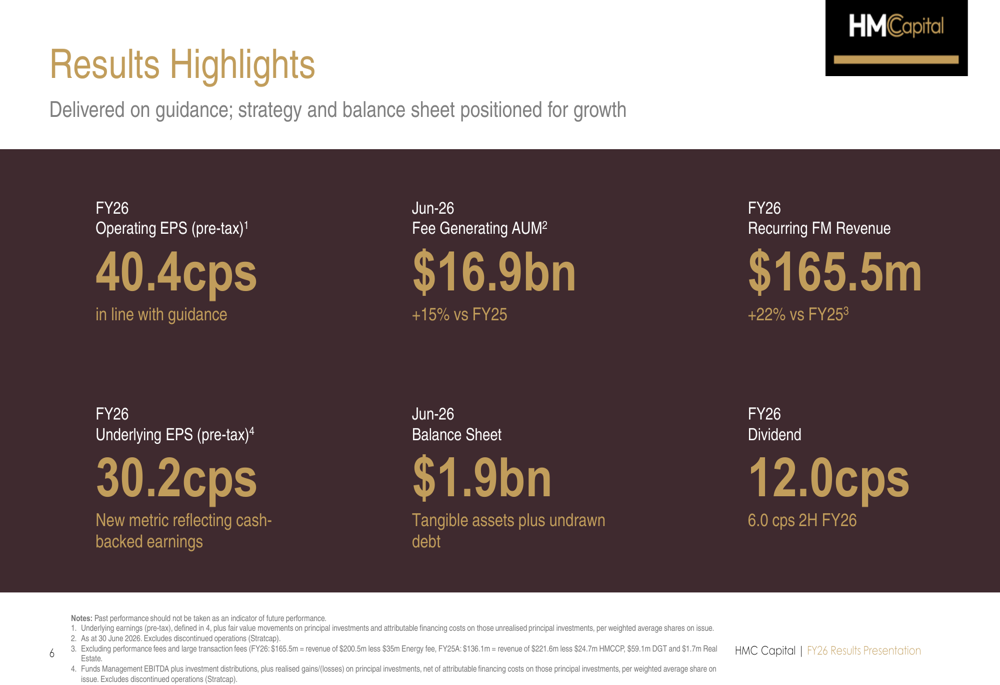
Fee-generating assets under management expanded 15% year-over-year to $16.9 billion, driven by institutional capital partnerships across all four business verticals. More significantly, recurring funds management revenue increased 22% to $165.5 million, reflecting the strategic shift toward more predictable income streams.
Management fee revenue rose 23% to $159.3 million, while transaction and performance fee revenue declined to $41.2 million from $91.6 million in FY25. This decline was expected and reflects the company’s deliberate pivot away from episodic, transaction-driven income toward sustainable management fees.
The company’s balance sheet strengthened considerably following the Energy platform transaction with KKR. Net tangible assets reached $1.2 billion, or $2.95 per share, while gearing declined to 10.7% from 20.5% in December 2025. Combined liquidity and investment capacity totaled approximately $1.9 billion, comprising $500 million in undrawn debt and $1.4 billion in balance sheet investments.
The detailed earnings breakdown shows the composition of the company’s FY26 performance across revenue streams and expense management.
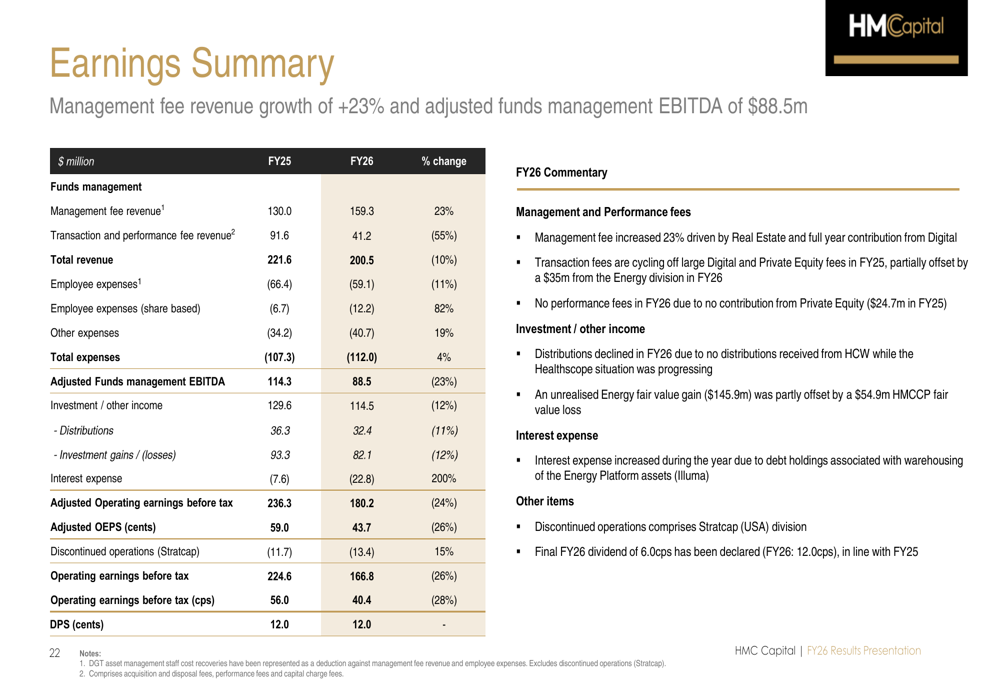
HMC Capital declared a final FY26 dividend of 6.0 cents per share, bringing the full-year dividend to 12.0 cents, consistent with the prior year. However, management guided to a 25% increase in FY27 dividends to 15 cents per share, supported by stronger recurring earnings growth.
Platform Growth & Strategic Progress
The presentation highlighted HMC Capital’s remarkable transformation from a $2.1 billion AUM platform in FY21 to $16.9 billion in FY26, representing compound annual growth of approximately 52%. Funds management revenues grew even faster, expanding from $19 million to $201 million over the same period, a 60% annual growth rate.
The company’s strategic evolution is illustrated in the following chart showing the dramatic expansion of both fee-generating AUM and funds management revenues across four key verticals.
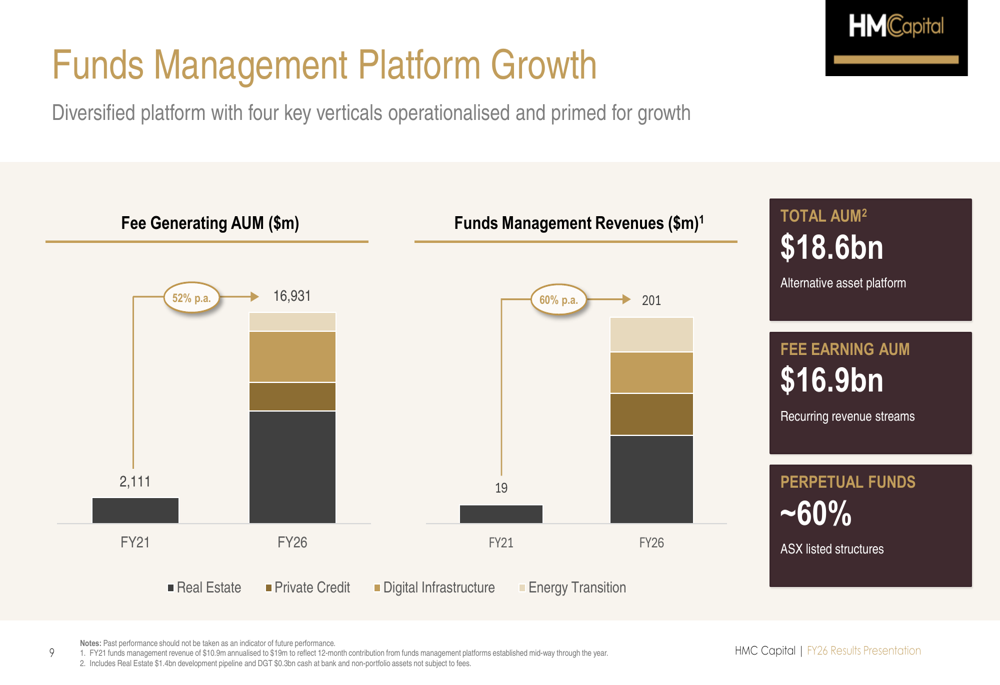
Management emphasized that approximately 60% of AUM is now held in perpetual fund structures, primarily ASX-listed vehicles, which provide greater earnings stability and reduce redemption risk. This structural advantage differentiates HMC Capital from traditional private equity managers with finite-life funds.
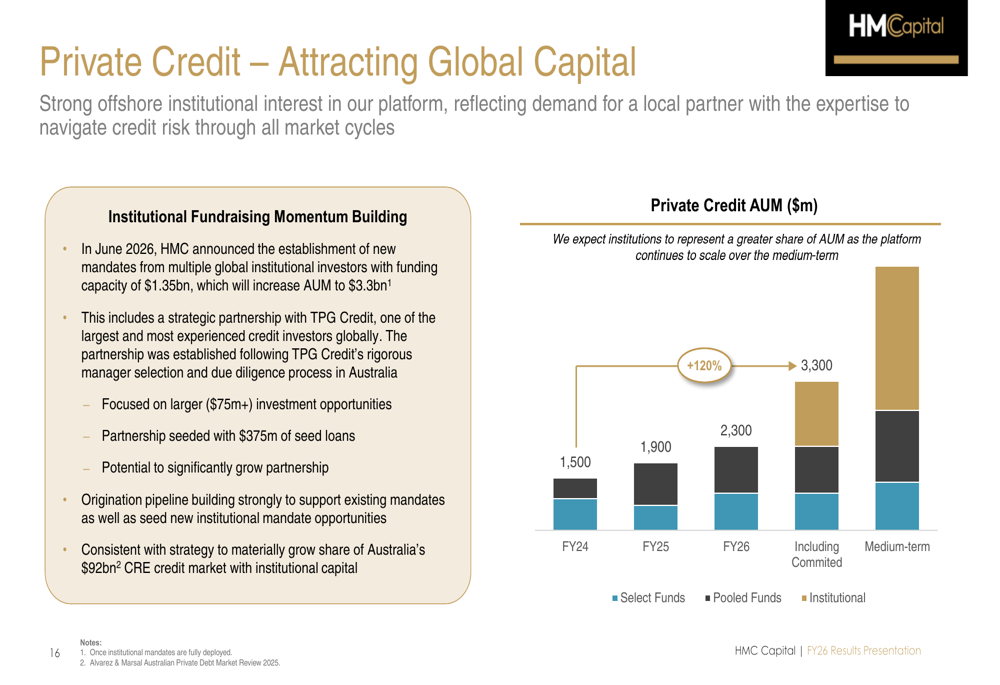
The company made tangible progress on its strategic objectives of simplifying operations, scaling platforms, and strengthening the balance sheet. Key achievements included securing $1.35 billion in institutional mandates for Private Credit, obtaining a $603 million commitment from KKR for the Energy platform, and growing unlisted institutional AUM by 15% in Real Estate.
As shown in the following strategic progress summary, the company delivered across multiple initiatives while maintaining cost discipline.
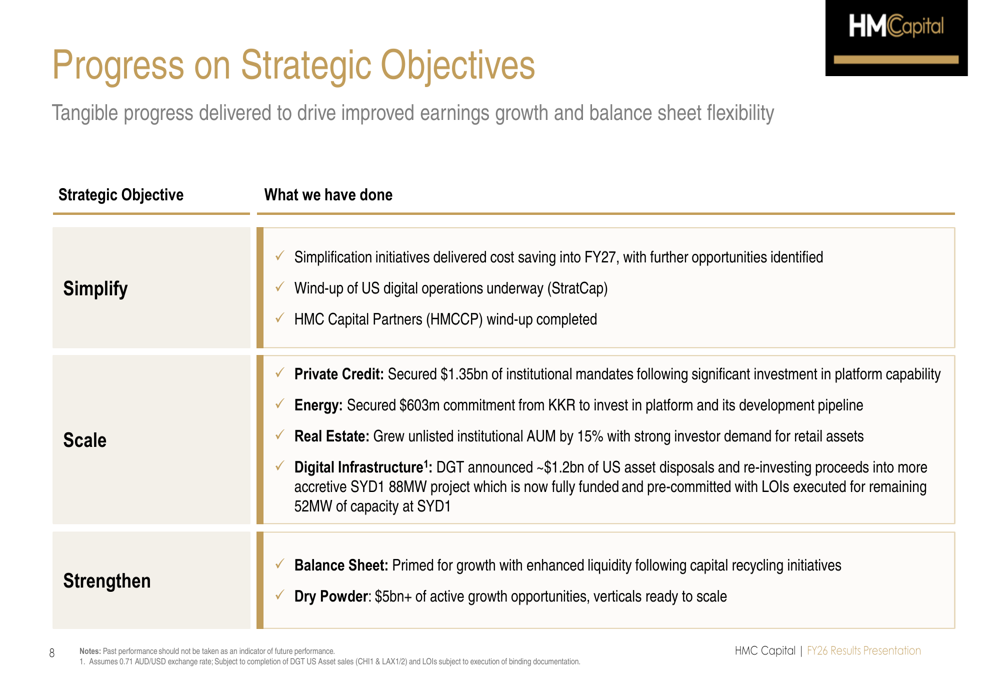
The Digital Infrastructure platform announced approximately $1.2 billion of U.S. asset disposals (CHI1 and LAX1 data centers), with proceeds being reinvested into the SYD1 88MW expansion project in Sydney. This strategic repositioning refocuses the platform on the Australian market while reducing gearing and improving returns.
Management also completed the wind-up of HMC Capital Partners (HMCCP), its private equity fund, and initiated the wind-down of U.S. digital operations (StratCap). These simplification initiatives are expected to deliver cost savings into FY27 while allowing management to focus on the four core verticals.
Four Vertical Business Segments
HMC Capital operates through four specialized verticals, each targeting long-term structural growth themes including demographics, decarbonization, digitalization, and deglobalization. The company has identified over $5 billion in active growth opportunities and dry powder across these platforms.
The following breakdown illustrates the scale of each vertical and the significant deployment capacity available for near-term growth.
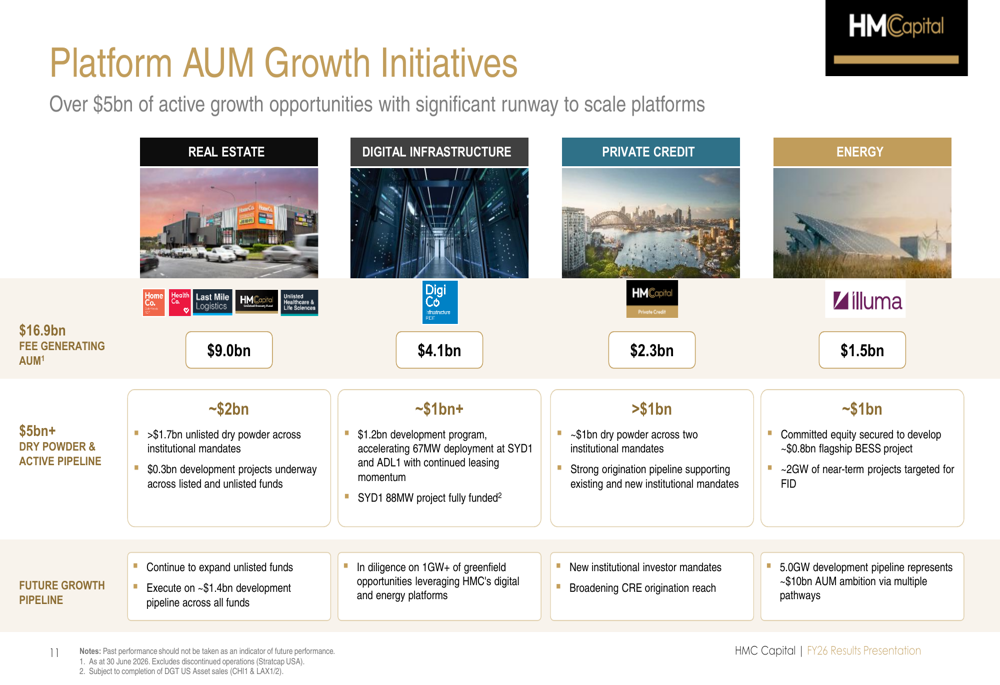
Real Estate ($9.0 billion AUM): The largest vertical focuses on retail and healthcare properties, with particular strength in grocery-anchored shopping centers and medical office buildings. Unlisted AUM grew 15% year-over-year to $2.9 billion, driven by institutional mandates. The platform has approximately $2 billion in identified deployment opportunities, including over $1.7 billion in unlisted dry powder and $300 million in development projects. Management highlighted market-leading performance with average internal rates of return exceeding 12% since inception.
Private Credit ($2.3 billion AUM): The commercial real estate lending platform has evolved rapidly into an institutional-grade operation. Committed AUM, including institutional mandates, reached approximately $3.3 billion, with a deal pipeline under evaluation of roughly $4 billion. The platform focuses on mid-market, short-duration lending across the development lifecycle.
The transformation of the Private Credit platform over the past two years represents a significant de-risking and professionalization of the business, as illustrated in the following comparison.
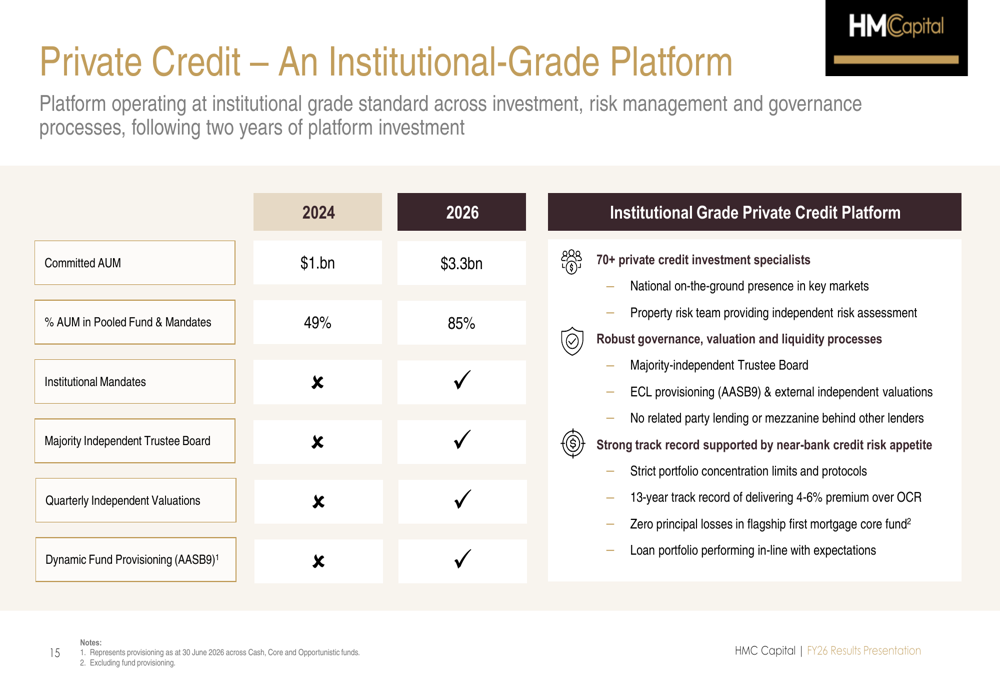
In June 2026, HMC announced new mandates from global institutional investors with funding capacity of $1.35 billion, including a strategic partnership with TPG Credit focused on larger investment opportunities. The platform now operates with 70+ investment specialists, a majority-independent trustee board, quarterly independent valuations, and dynamic fund provisioning under AASB9 accounting standards.
Management emphasized the platform’s conservative underwriting, with the pooled fund maintaining an average loan-to-value ratio of 58%, well below the 70% target maximum. The platform has delivered a 13-year track record of 4-6% returns above the official cash rate with zero principal losses in its flagship first mortgage core fund.
The growth trajectory of Private Credit AUM, including committed capital, demonstrates the strong institutional demand for the platform’s capabilities.
Digital Infrastructure ($4.1 billion AUM): The data center platform, operating through DigiCo Infrastructure REIT (), delivered strong FY26 results with underlying EBITDA of $127 million, slightly exceeding guidance of $125 million. The strategic refocus on Australia following the U.S. asset sales reduced gearing from 39% to 18% and increased liquidity to approximately $1.2 billion.
The SYD1 88MW expansion project is fully funded, with letters of intent executed for the remaining 52MW of capacity. Phased completion is expected in FY27 and FY28. The platform is also progressing a 15MW brownfield expansion at ADL1 in Adelaide and evaluating longer-term greenfield opportunities exceeding 1GW. Management projects Australian platform stabilized EBITDA of approximately $250 million post-completion of the SYD1 and ADL1 expansions.
Energy ($1.5 billion AUM): The renewable energy and battery storage platform, now branded Illuma Energy following the KKR partnership, has transitioned from balance sheet seeding to institutional capital. The platform comprises 652MW of installed operating capacity (85% contracted) and a development pipeline of approximately 5GW across 19 projects.
The strategic evolution of the Energy platform demonstrates HMC Capital’s ability to seed, scale, and syndicate platforms while retaining meaningful upside exposure.
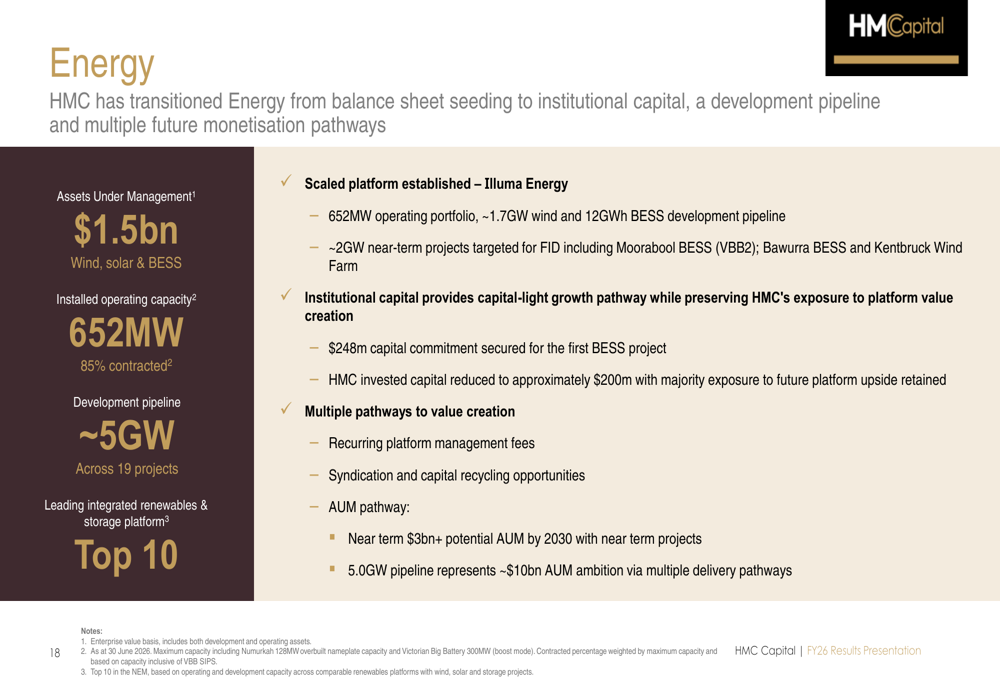
HMC secured $248 million in committed equity capital for the first BESS (battery energy storage system) project, the 300MW Moorabool facility in Victoria. This transaction reduced HMC’s invested capital to approximately $200 million while maintaining exposure to platform appreciation. Near-term projects targeted for final investment decision include Moorabool BESS, Bawurra BESS (up to 550MW in Queensland), and Kentbruck Wind Farm (600MW in Victoria).
Management outlined a pathway to $3 billion+ in potential AUM by 2030, with a 5.0GW development pipeline representing approximately $10 billion in AUM ambition. The platform generates multiple value creation pathways including recurring management fees, syndication opportunities, and capital recycling.
Balance Sheet Strength & Capital Management
HMC Capital’s balance sheet strategy centers on using proprietary capital to seed new platforms and investments, then recycling that capital through syndication to institutional partners. This approach allows the company to capture both upfront transaction economics and ongoing management fees while maintaining capital efficiency.
The company’s capital allocation strategy is shifting toward a higher proportion of principal investments, as illustrated in the following breakdown of invested capital by strategy.
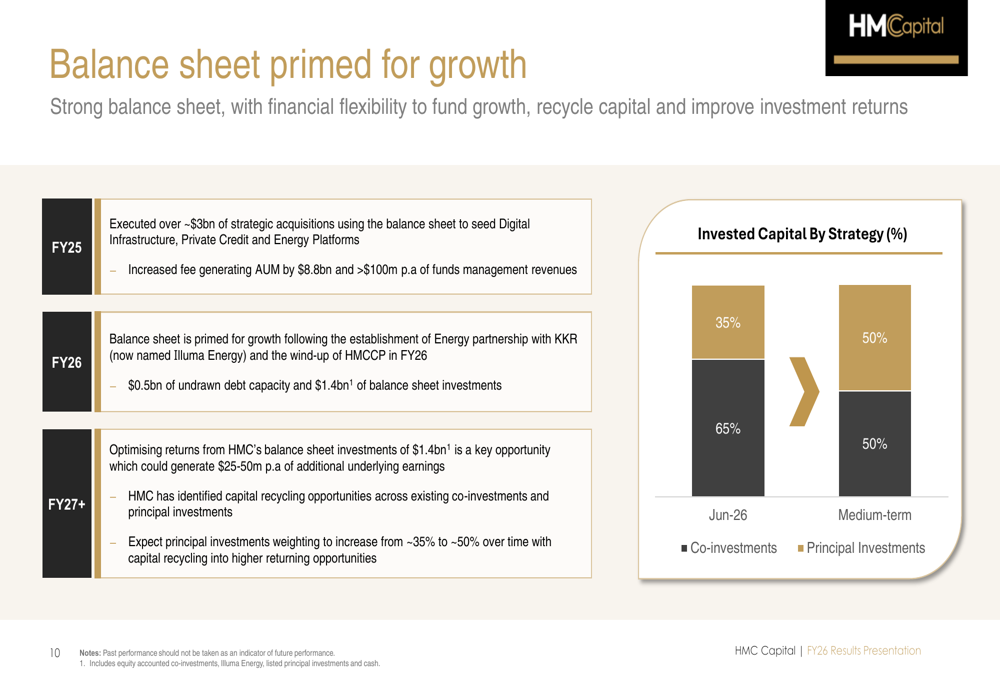
In FY25, HMC executed over $3 billion in strategic acquisitions to seed the Digital Infrastructure, Private Credit, and Energy platforms, increasing fee-generating AUM by $8.8 billion and adding more than $100 million in annual funds management revenues. In FY26, the balance sheet was primed for the next growth phase following the Energy partnership with KKR and the HMCCP wind-up.
Looking ahead to FY27 and beyond, management expects to optimize returns from the $1.4 billion in balance sheet investments to generate $25-50 million annually in additional underlying earnings. The company has identified capital recycling opportunities and expects the principal investments weighting to increase from approximately 35% to 50% over time, reflecting higher-return opportunities in direct investments versus co-investments in listed vehicles.
The balance sheet summary shows the composition of assets and the improved financial flexibility following recent transactions.
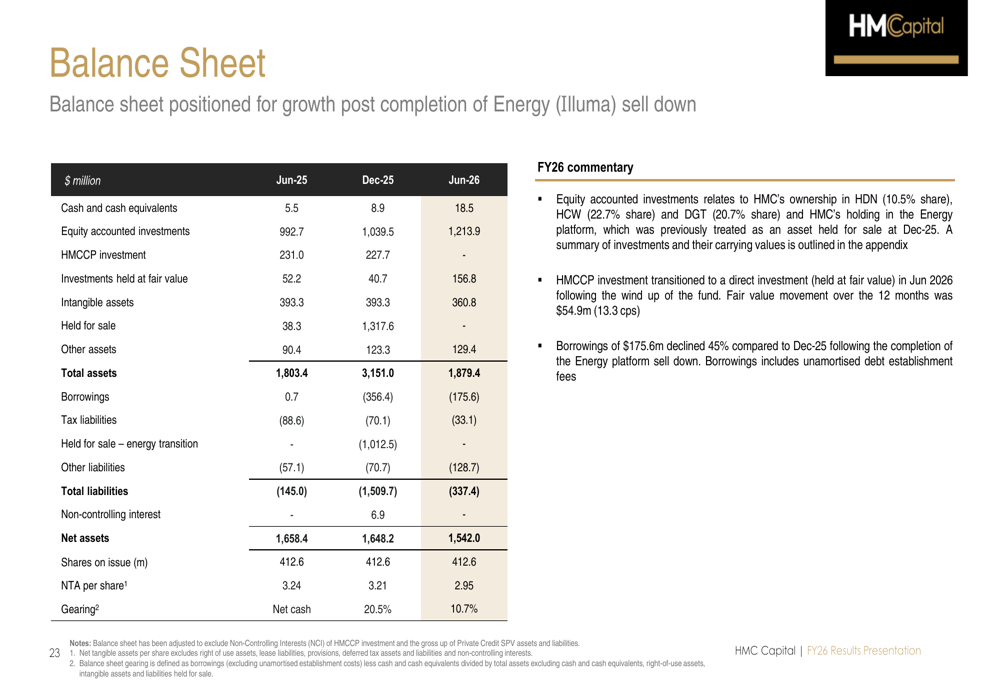
Drawn debt declined 45% from December 2025 to $175.6 million at June 2026, with an additional $42.9 million in bank guarantees. The company maintains $715 million in total debt facilities maturing in November 2027, leaving $495.5 million in undrawn capacity. Weighted average cost of debt stood at 6.5%, and the company remains well within its financial covenants, with a gearing ratio covenant of less than 50% (actual: 10.7%) and an interest coverage ratio covenant above 3.0x.
Forward-Looking Guidance & Strategic Outlook
Management provided confident guidance for FY27, projecting underlying earnings per share of at least 35 cents, representing 16% growth from FY26 on a reported basis. Excluding the $35 million energy transition fee capital charge earned in FY26, the underlying growth rate would be approximately 60%.
The FY27 outlook is supported by three primary drivers, as detailed in the following guidance summary.
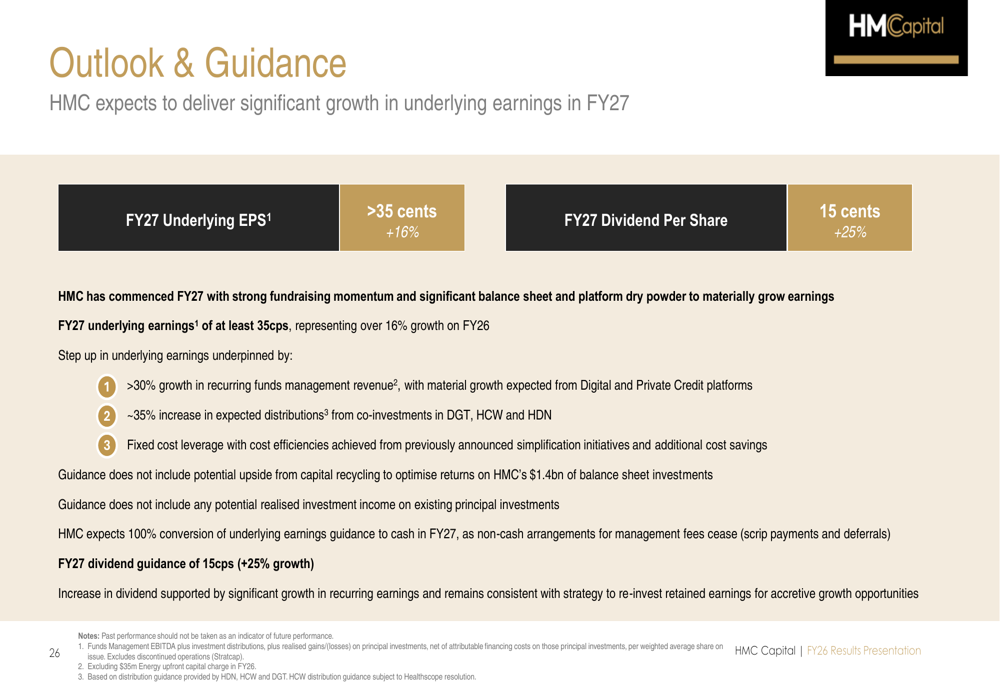
First, recurring funds management revenue is expected to grow by more than 30%, driven particularly by the Digital Infrastructure and Private Credit platforms. Second, co-investment distributions from DigiCo Infrastructure REIT, , and are projected to increase approximately 35%. Third, the company will benefit from fixed cost leverage as cost efficiencies from simplification initiatives take effect.
Notably, management emphasized that the guidance excludes potential upside from capital recycling, realized investment income, or unrealized fair value gains. The company expects 100% conversion of underlying earnings guidance to cash in FY27, with no cash tax expected during the period.
The dividend guidance of 15 cents per share for FY27 represents 25% growth from FY26 and is supported by the strong recurring earnings trajectory. Management indicated a strategy to reinvest retained earnings into growth opportunities while progressively increasing the payout ratio as the earnings base expands.
Chief Executive David Di Pilla stated: “FY 2026 was a year of disciplined execution against our key strategic priorities, leaving the business well-positioned for growth in FY 2027. Our purpose is simple, to create value in quality real assets through operational expertise, particularly where we see opportunities that are overlooked, underutilized, or can benefit from active management.”
He added: “Since 2021, fee generating AUM has grown from just over AUD 2 billion to AUD 17 billion, representing a compound growth rate of approximately 52% per annum.”
Sustainability & Governance
HMC Capital outlined progress on its sustainability framework, aligning environmental, social, and governance initiatives with the company’s expanded portfolio. The Illuma Energy platform directly supports decarbonization objectives, while real estate developments achieved 4 Star Green Star Buildings certifications.
On the social front, the HMC Capital Foundation made grants to nine charitable organizations, including six university scholarships for First Nations and regional students. The company improved gender diversity to 67% female representation in independent board director positions and 37% female employees overall. HMC achieved an MSCI ESG rating of ’A’ as of 2026 and published its inaugural Modern Slavery Statement in December 2025.
Risks & Challenges
Despite the positive outlook, HMC Capital faces several operational and market risks. The Private Credit platform has experienced some redemption activity, though management noted that net inflows remain positive and the impact is negligible. The platform’s conservative underwriting and focus on first mortgage lending provides some protection, but commercial real estate credit markets remain sensitive to interest rate movements and economic conditions.
The wind-down of StratCap U.S.A. will continue to generate some costs in FY27, though these are expected to decline over time. The Energy platform, while strategically important, is being treated as a long-term investment and is not expected to contribute meaningful distributions in the near term, limiting its impact on underlying earnings.
More broadly, the company’s growth projections depend on successfully deploying over $5 billion in dry powder and pipeline opportunities across the four verticals. Execution risk exists around development projects, particularly in the Energy and Digital Infrastructure segments, where construction delays, cost overruns, or changes in market conditions could affect returns.
Management acknowledged these challenges while expressing confidence in the quality of the platform and the structural tailwinds supporting each vertical. The company’s diversification across four distinct asset classes and its focus on long-duration capital partnerships provide some insulation against sector-specific headwinds.
Full presentation:
This article was generated with the support of AI and reviewed by an editor. For more information see our T&C.










Leave a comment