
By Rajendra Gupta, Aashish Gaurav, Akash Desai
Recovered carbon black (rCB) is gaining strategic importance as a sustainable, circular alternative that supports tyre manufacturing decarbonisation while converting end-of-life tyres into a valuable, circular feedstock. However, despite its clear sustainability and economic potential and growing industrial interest, rCB has not yet achieved the status of a true global commodity. This is primarily due to the absence of universal specifications/testing methods, variability in product quality driven by feedstock and process inconsistencies, limited interchangeability between suppliers, fragmented supply chains, and a lack of transparent, standardised pricing mechanisms.
Advances in global-scale, continuous pyrolysis technologies, particularly those capable of delivering high yields at consistent product quality against feedstock variance via improved temperature regulation, residence time control, devolatilisation efficiency are beginning to address some of these constraints. A case in point is TyreNova℠ technology advanced by KBR and Klean, which is specifically designed to reduce variability and enhance the physicochemical consistency of rCB. Such developments provide the technical foundation required for standardisation and broader market acceptance. While these advancements alone do not fully resolve structural market challenges, they represent a critical step toward positioning rCB as a specification-driven, scalable industrial material rather than solely a sustainability-led alternative.
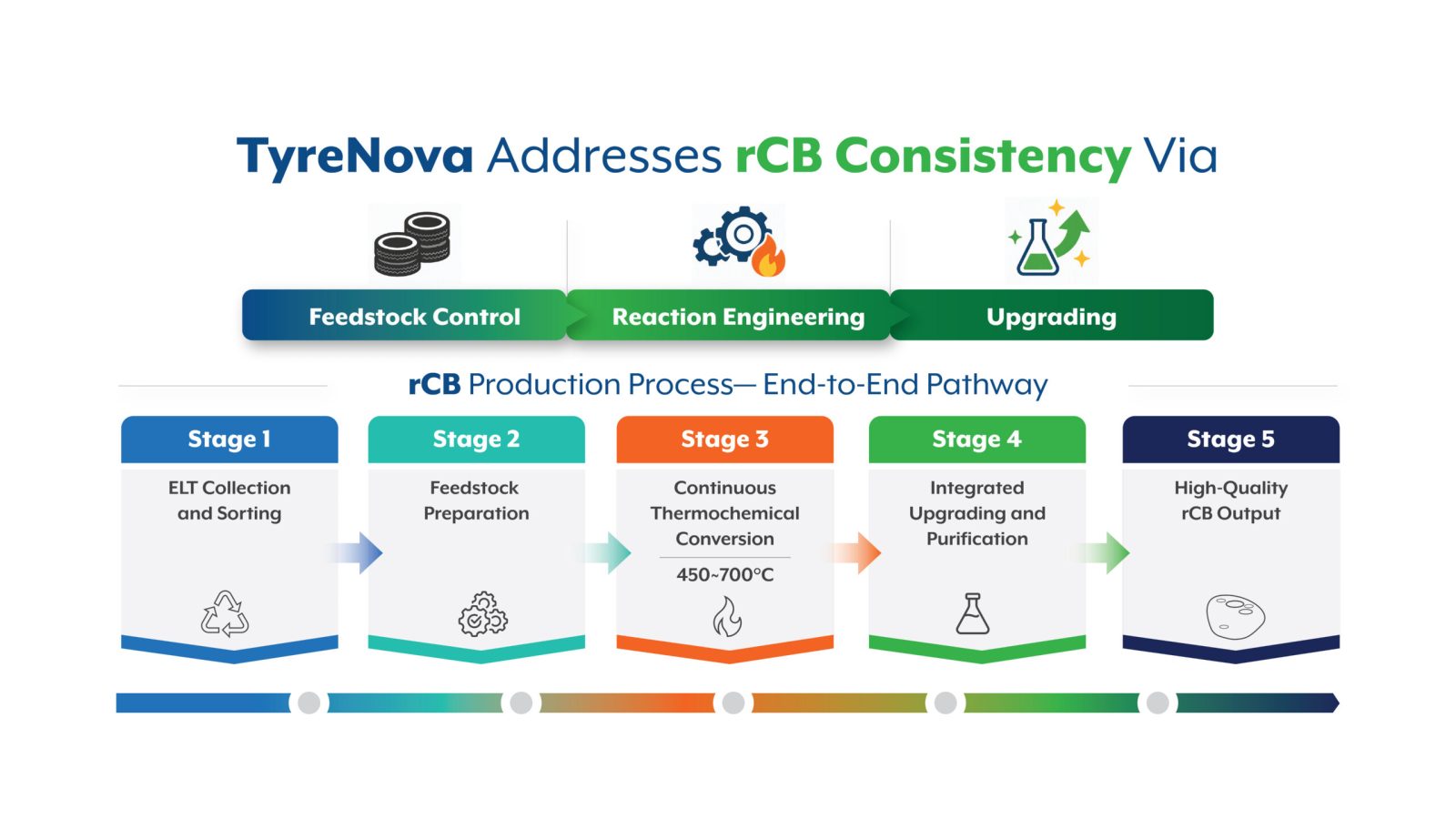
TyreNova offers a comprehensive, proven solution encompassing the key elements required to produce consistent, high-quality rCB. This article presents the structured engineering framework underpinning the TyreNova process and how it supports the transition of rCB toward a scalable, specification-based commodity. The framework addresses critical technical pillars, including reaction engineering, feedstock control, and upgrading processes, with the objective of enabling global deployment of tyre pyrolysis while accelerating rCB production volumes, standardisation, and market acceptance.
Feedstock Control, Supply Chain Management and its Impact on rCB Properties
Feedstock control is a critical determinant of both pyrolysis process performance and quality of rCB. Variations in tyre composition including differences in tyre type, filler content, moisture and contaminants directly influence reaction kinetics, heat transfer, and devolatilisation behaviour. Inconsistent feed can lead to temperature fluctuations, incomplete conversion, and variability in product yield and stability. From an rCB perspective, this results in differences in ash content, surface chemistry, structure, and residual volatiles, all of which impact downstream application performance.
Structured feedstock management is therefore essential to ensure process stability and product consistency. This includes sourcing defined and limited feedstock types, sorting by tyre category, controlling contamination, and implementing pre-processing steps such as shredding to a narrow and optimised particle size distribution, along with precise removal of steel and fabric. These measures establish the first and most impactful layer of quality assurance, enabling stable reactor operation, improved heat and mass transfer, and consistent rCB physicochemical properties.
At industrial scale, feedstock control extends into supply chain engineering. Long-term sourcing agreements, optimised logistics for regional aggregation, inventory buffering, and contractual feedstock specifications are necessary to maintain steady throughput and predictable operations. Reliable feedstock integration not only reduces process variability but also strengthens commercial confidence.
Reaction Engineering
In Tyre Pyrolysis, the reactors operates under oxygen-free conditions at temperatures of 450–700°C, thermally decomposing rubber polymers into volatile fractions principally hydrocarbon oils and non-condensable gases, while retaining the carbon-rich solid phase that forms the rCB [1,3]. The fundamental objective of this stage is controlled polymer breakdown without excessive structural degradation of the carbon matrix, which would reduce surface activity and compromise reinforcement performance.
Continuous reaction engineering is a key enabler of industrial-scale reproducibility in rCB manufacturing. Unlike early batch systems—characterised by thermal gradients, variable residence times, and inconsistent devolatilisation—continuous systems provide steady-state operation, controlled material flow, and stable thermal conditions. This significantly reduces product variability and supports consistent carbon structure and surface chemistry, both critical for achieving defined and reliable material properties. [4].
Beyond quality consistency, continuous systems offer higher volumetric throughput improved plant availability and scalable capacity expansion [6]. As such, continuous operation is not only an efficiency improvement but a fundamental requirement for establishing the reproducibility, reliability, and supply stability needed to position rCB as a specification-driven industrial commodity.
This is precisely the industrial logic underpinning TyreNova’s approach. TyreNova’s continuous pyrolysis platform is engineered to meet these commodity-grade demands through a suite of performance-backed commitments, including:
- Guaranteed quality and yield consistency, ensuring that rCB output meets defined specifications batch-over-batch, enabling customer confidence and supply chain integration;
- Modular and scalable plant architecture, allowing operators to expand capacity incrementally in response to market demand without compromising process continuity or product reliability;
- High plant availability, achieved through system redundancy and continuous operational design, minimising downtime and reinforcing the supply predictability that commodity markets require.

Integrated Upgrading and Purification
Upgrading and purification represent the final quality-conditioning stage in rCB production and are indispensable to achieving specification-aligned material. Following thermochemical conversion, rCB typically contains residual metals, mineral ash derived from tyre fillers, and trace volatile hydrocarbon compounds that must be systematically reduced to meet specifications requested by offtakers and clients [2].
Mechanical separation systems incorporating magnetic separation, air classification, and screening remove embedded steel wire and metallic residues. Controlled post-treatment thermal conditioning enhances devolatilisation completeness and stabilises surface chemistry by decomposing residual adsorbed hydrocarbons. These steps collectively reduce impurity variability, improve material cleanliness, and enhance pelletisation characteristics critical for pneumatic conveying and industrial handling [2,5].
Beyond impurity removal, upgrading processes plays a key role in ensuring structural and chemical consistency by stabilising surface functionality and minimising residual hydrocarbon content.
The integration of these refinement stages ensures reproducible physicochemical properties — forming the basis for standardised and industrial applications [5]. Effective upgrading therefore functions as the critical bridge between thermochemical recovery and specification-controlled industrial application.

Conclusions
rCB has potential to enable material circularity and decarbonisation across tyre, rubber, ink and multiple industries. Progress in standardisation, growing OEM commitments, and regulatory pressure are striving to position rCB as a credible supply chain material rather than a purely sustainability-driven alternative.
Achieving this transition requires the convergence of consistent engineering, agreed testing methodologies, scalable production systems, and secure feedstock supply. Technologies such as TyreNova are playing a key role in this shift by enabling large-scale, continuous pyrolysis and delivering the consistency required for broader market acceptance.
REFERENCES:
[1] Martínez, J.D.; Puy, N.; Murillo, R.; García, T.; Navarro, M.V.; Mastral, A.M. Waste tyre pyrolysis—A review. Renew. Sustain. Energy Rev. 2013, 23, 179–213. https://doi.org/10.1016/j.rser.2013.02.038
[2] Banala, S.; Salogni, A.; Broggi, A.; Cha, D.; Acharya, B. Production and upgrading of recovered carbon black from the pyrolysis of waste tyres. Chem. Eng. J. 2024, 475, 145981. https://doi.org/10.1016/j.cej.2023.145981
[3] Williams, P.T. Pyrolysis of waste tyres: A review. Fuel 2013, 105, 31–46. https://doi.org/10.1016/j.fuel.2012.08.007
[4] Zhang, X.; Li, H.; Cao, Q.; Jin, L.; Wang, F. Upgrading pyrolytic carbon black from waste tyres to recovering carbon black. Chem. Eng. J. 2022, 430, 132789. https://doi.org/10.1016/j.cej.2021.132789
[5] Chen, W.; Meng, X.; Han, J.; Chen, W. Comparison between recovered carbon black (rCB) from pyrolysis and commercial carbon black (CCB) with respect to characterisation and application. Carbon 2022, 190, 195–206. https://doi.org/10.1016/j.carbon.2021.12.026
[6] International Energy Agency. Circular Carbon Economy: Key Performance Indicators; IEA: Paris, France, 2023.
NOTE: This page is an advertorial and contains sponsored content. The views, opinions, and statements expressed in this article are provided directly by the advertiser/sponsor.










Leave a comment