
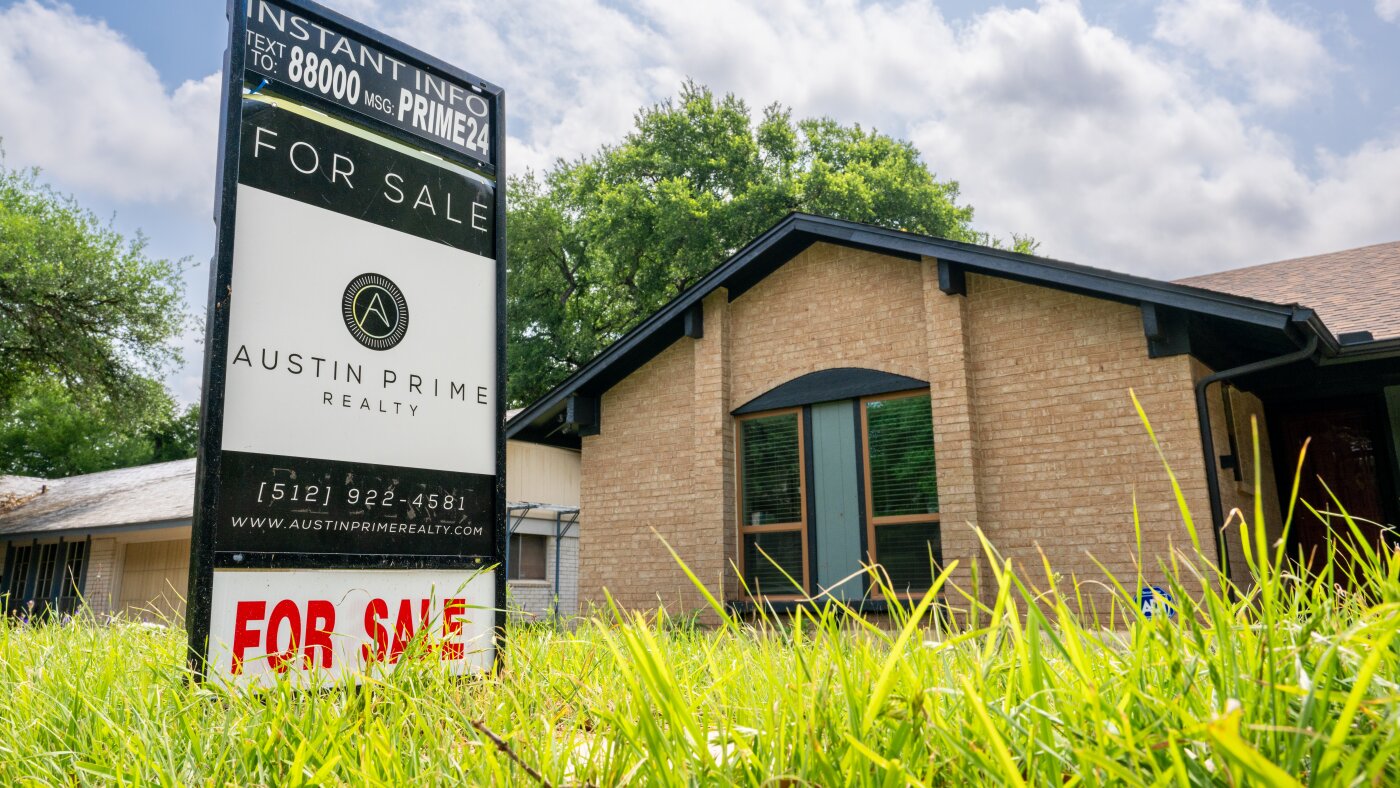

A home is seen for sale on April 24 in Austin, Texas.
Brandon Bell/Getty Images
hide caption
toggle caption
Brandon Bell/Getty Images
President Trump blames the country’s high home prices on one of his frequent targets: Federal Reserve Chair Jerome Powell.
Trump argues that the Fed, which sets interest rates that help determine mortgage rates, should lower interest rates and that the move would help people afford homes.
Home prices hit an all-time high in June, and sales dropped to a nine-month low as hopeful first-time buyers shied away, likely due to elevated mortgage rates and high listing prices.
“People aren’t able to buy a house because this guy is a numbskull,” Trump said in the Oval Office this week referring to Fed Reserve Chair Powell. “He keeps the rates too high and probably doing it for political reasons.”
But Robert Reich, who served as Labor secretary under President Bill Clinton, told Morning Edition that the move Trump wants could backfire, putting an already seemingly unreachable goal further out of reach for many Americans.
Here are three thoughts Reich, now a professor of public policy at the University of California, Berkeley, shared in an interview with NPR’s Sacha Pfeiffer about lowering interest rates and what the Trump administration could actually do to lower prices.
The Fed cutting interest rates could make mortgages cheaper, but …
In terms of simple math, Reich says housing can get less expensive if the Fed cuts interest rates and that causes mortgage rates to go down.
“I can buy a house more cheaply because I can get a loan to buy that house more cheaply,” Reich said.
But cutting interest rates might not cause mortgage rates to fall, Reich noted, because it could lead to questions about the Fed’s credibility in fighting inflation.

“If investors believe that the Fed is really not serious about fighting inflation by raising or keeping interest rates high, then ironically, mortgage rates are going to not fall. They’re going to potentially rise,” Reich said.
And markets take into account the risk of long-term inflation, he added.
“They’re taking the possibility that next year or the year after, prices are going to go up, that inflation is going to get out of control,” Reich said. “Markets are responding to what markets assume are going to be the incentives operating upon the Fed.”
A rush of demand could make homebuying harder.
If the Fed decided to cut interest rates because it independently finds that inflation is less of a challenge, Reich said the basics of supply and demand would play a big role in home prices.
“Then it’s possible that there is more of a demand for housing. That greater demand for housing without corresponding increase in the number of housing units available could push up prices,” Reich said.

Meeting demand through new builds right now is tough — and tariffs aren’t helping.
Reich said he doesn’t expect to see very much new housing being built because builders are “facing among the worst of circumstances.”
The construction of new homes has been iffy this year. Last month, builders were requesting fewer permits, starting fewer homes and completing fewer housing units compared to a year earlier, according to Census Bureau data.
Trump’s tariffs may also be playing a role, as materials used in construction are now more costly to bring into the country. The National Association of Home Builders says Canadian lumber and other materials like steel and aluminum, as well as home appliances, all face steeper tariffs and are pushing up costs.
Reich said the White House could reduce homebuying costs by lowering its tariffs, which would allow building equipment and materials to the U.S. at lower costs. He added that making it easier for builders to get permits and for builders and states and localities to comply with a variety of housing regulations may also help.
“Now, it’s easy to say all these things,” Reich said. “Other administrations have tried to bring housing prices down, but it’s very difficult.”
This digital article was edited by Treye Green. The radio version was edited by Ally Schweitzer and HJ Mai.









Leave a comment