

Key Takeaways
- A court can declare ownership over a wallet address. It cannot move the funds inside it.
- Without the original private key, any judgment remains practically unenforceable against the blockchain itself, regardless of what it says on paper.
- Article 7-B of the Personal Property Law governs physical and intangible found property held by individuals.
- Wallets belonging to non-US nationals exist outside New York’s property regime.
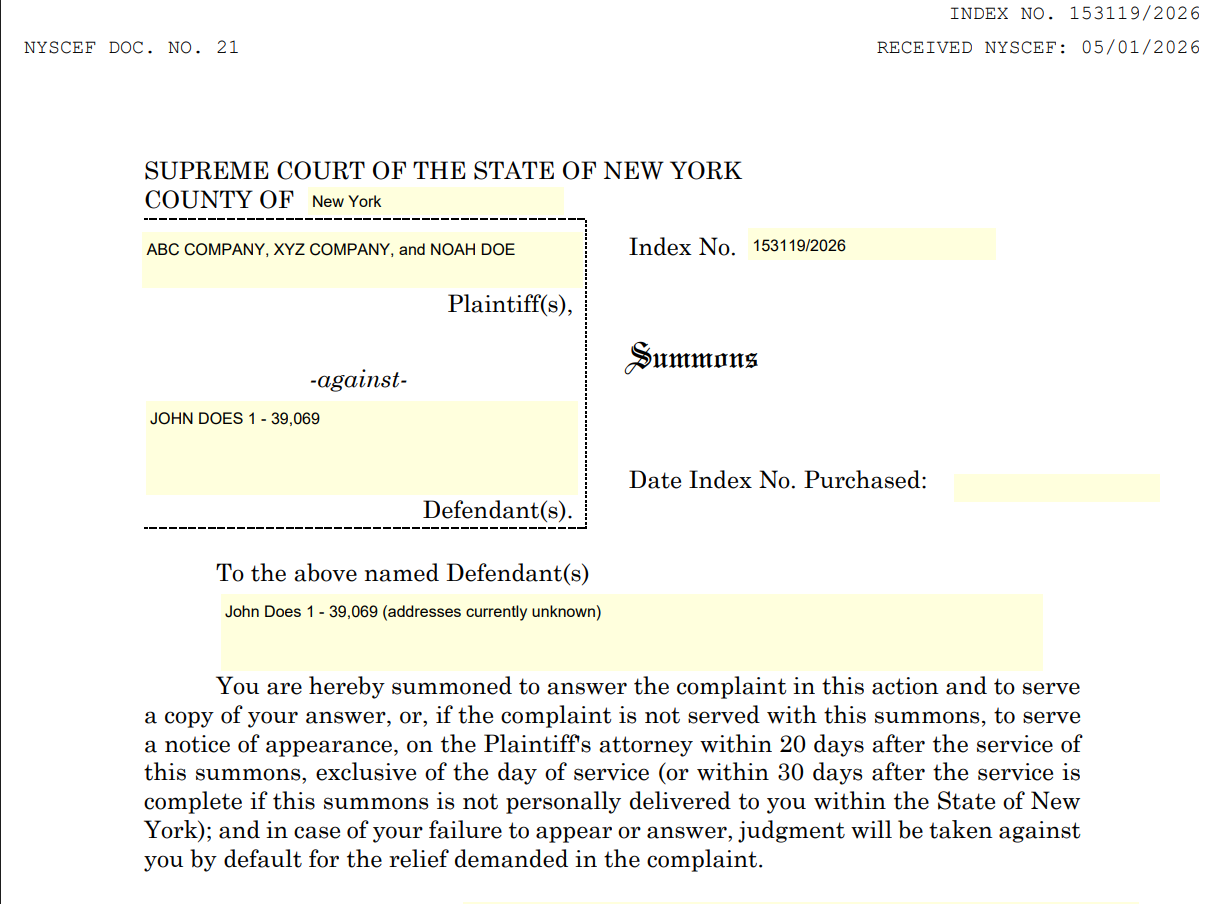
On May 1, 2026, a first-of-its-kind lawsuit filed in New York Supreme Court asked a judge to declare that 39,069 dormant cryptocurrency wallets, inactive for at least six years, legally belong to the person who found them.
Filed under Index No. 153119/2026 and assembled by Brooklyn-based law firm Lewis & Lin LLC, the case stretches New York’s century-old lost property statutes into territory no court has formally mapped: self-custodied digital wallets treated as found objects on a public blockchain.
If the court agrees, the precedent could reshape how abandoned crypto is categorized, claimed, and ultimately monetized across the United States. If it does not, the case nonetheless exposes a structural gap in every lost property framework currently on the books.
How 39,069 Wallets Became Found Property
Between December 2024 and April 2025, the plaintiff identified as Noah Doe used a proprietary algorithm to scan public blockchain data and identify wallets meeting specific abandonment criteria. The methodology was deliberate: wallets inactive for at least five years, whose period of dormancy included sustained cryptocurrency price increases that any rational owner would have acted on, were flagged as likely abandoned.
Noah Doe found the wallets across three separate discovery events: 1,625 wallets (1,544 after duplicates) in December 2024, 546 in March 2025, and 39,911 in April 2025. He excluded any wallet appearing to be held by a third-party custodian such as an exchange, limiting the pool to self-custodied wallets where owners had made a deliberate choice to hold their own private keys.
Critically, Noah Doe did not crack or compromise any wallet. What he captured were public keys, the blockchain addresses visible to anyone with a network connection. Private keys remain with their original owners or, in the majority of these cases, appear to have been lost permanently.
NYPD USB Drives and the OP_RETURN Notice Campaign
Noah Doe’s compliance with New York’s found property framework was meticulous, and deliberately so. On three separate occasions corresponding to each discovery batch, he brought USB drives containing the wallet addresses to the NYPD’s 17th Precinct.
Under New York Personal Property Law Section 252(1), a finder of lost property must deliver it to law enforcement. NYPD issued receipts and property invoices, creating a documented chain of custody. The agency returned the drives after periods ranging from four to eleven months.
Noah Doe then launched what may be the most technically novel notice campaign in the history of American property law. Using OP_RETURN, a blockchain technique that allows a small data payload to be permanently embedded in a transaction, his team inserted a message into every single found wallet directing its address to a webpage hosted by Salomon Brothers Strategic Advisors Inc. The page explained the abandonment determination and provided a 90-day window for owners to come forward, anonymously or otherwise.
In August 2025, a global press release went to over 820 media outlets across 37 countries. Galaxy Digital published a separate report circulated to its institutional client base. The story reached an estimated 10 million people directly and up to 225 million through secondary exposure via word of mouth, follow-on coverage, and the persistent availability of online articles.
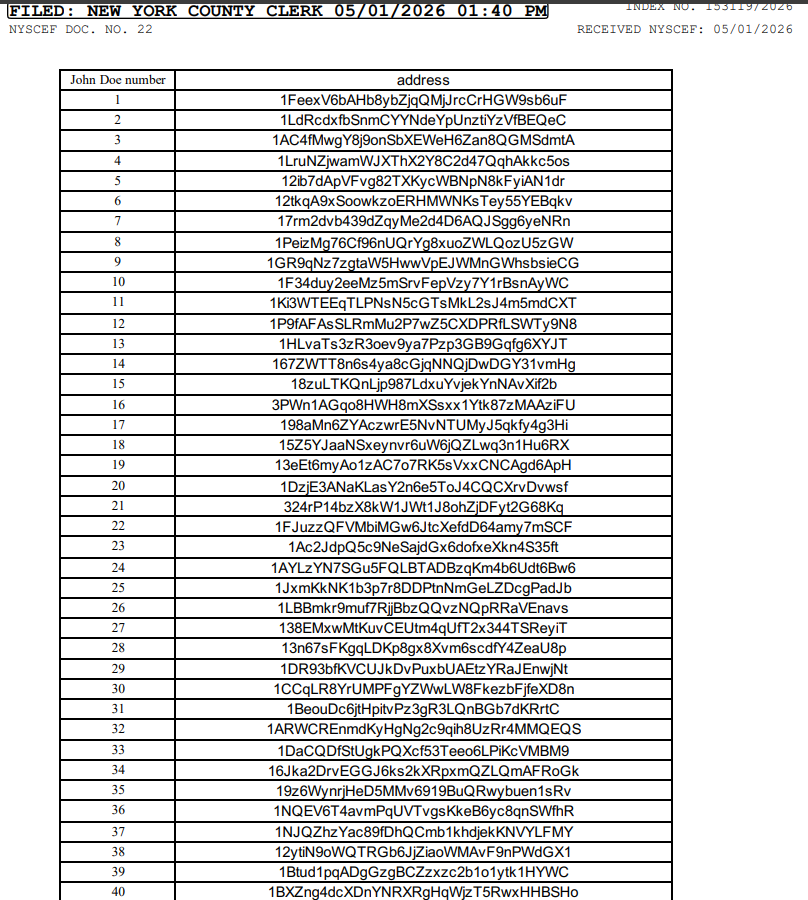
Out of 42,001 net wallets originally identified, 2,932 were removed for various reasons, including 424 that responded by taking on-chain action to demonstrate active ownership. The remaining 39,069 wallets took no action and are named in the complaint as the defendants.
Legal Architecture: Wallets as Bank Accounts, Public Keys as Found Objects
The complaint’s core legal argument is that a digital wallet constitutes property in the same sense that a bank account does. Both are intangible, ledger-based, electronically interfaced, and uniquely identifiable by a combination of network identifier and account address. A bank account is not considered destroyed when its owner’s signature is unavailable. By the same logic, a digital wallet does not cease to exist as property when its private key is lost.
Under N.Y. Personal Property Law Section 257, title to lost property vests in the finder upon either delivery back by NYPD under Section 254 or the passage of one year after the finding, whichever occurs first. Noah Doe invokes both pathways across the three wallet batches, with title vesting dates of December 26, 2025, March 31, 2026, and April 14, 2026.
By December 2025, Noah Doe had transferred ownership rights in all but 18 wallets to ABC Company, a Wyoming LLC he wholly owned. He then transferred 98% of his membership interest in ABC Company to an irrevocable trust, retaining 2% personally. ABC Company subsequently transferred 17.7% of the wallets to XYZ Company, another Wyoming LLC. All three plaintiffs now collectively hold the claimed wallets and seek a declaratory judgment under CPLR Section 3001 confirming their ownership.
The action is structured as a quiet title proceeding, the mechanism courts have used for generations to resolve competing or uncertain claims on real property. Applying that framework to blockchain addresses represents a genuine legal first.
Understanding the Difference Between Lost, Abandoned and Dormant Bitcoin
While the terms are often used interchangeably, lost, abandoned and dormant Bitcoin represent very different situations in the crypto ecosystem. The distinction mainly comes down to wallet access, owner intent and the likelihood of funds ever moving again.
Lost Bitcoin refers to coins that are effectively unrecoverable because the private keys have disappeared. Dormant Bitcoin, on the other hand, simply describes wallets that have remained inactive for years despite still potentially being under the owner’s control. Abandoned Bitcoin sits somewhere in between, where wallets appear inactive long enough for others to question whether the original owner still exists or intends to reclaim the assets.
| Features | Lost Bitcoin | Abandoned Bitcoin | Dormant Bitcoin |
| Definition | Bitcoin inaccessible due to lost private keys | Bitcoin presumed ownerless or permanently unclaimed | Bitcoin inactive for a long period |
| Owner Status | Owner may exist but lost access | Owner presumed absent, deceased, or unreachable | Owner likely still active |
| Wallet Access | Impossible without keys | Potentially claimable through legal routes | Fully accessible by owner |
| Chance of Recovery | Extremely low | Uncertain / legally disputed | High |
| Blockchain Activity | Never moves | Usually inactive for years | Can reactivate anytime |
| Legal Implications | Treated as unrecoverable assets | May trigger ownership disputes | Generally none |
| Market Impact | Reduces circulating supply permanently | Could affect future ownership laws | Often seen as long-term holding behavior |
| Common Cause | Lost passwords, destroyed devices | Forgotten estates, vanished holders | Strategic long-term holding |
| Example | Early BTC wallets with lost keys | Wallets in New York abandoned-property lawsuit | Old whale wallets holding BTC untouched |
These categories are becoming increasingly important as regulators, courts and blockchain researchers debate ownership rights over inactive crypto wallets and the long-term impact of permanently inactive coins on Bitcoin’s circulating supply.
What Makes Abandoned Crypto Different From Traditional Lost Property
New York’s standard unclaimed virtual currency framework, codified under Abandoned Property Law Section 1319 since November 2022, applies specifically to virtual currency held by entities engaged in virtual currency business activity, meaning exchanges and custodians. That statute mandates a five-year dormancy period before the holding entity must report and deliver the asset to the State Comptroller.
Noah Doe’s case operates under a completely different statutory framework. Personal Property Law Article 7-B governs physical and intangible property found by private individuals, not institutional holders. No court in New York, and arguably no court anywhere, has ruled on whether a blockchain wallet address captured from public data qualifies as property “found” under that framework.
The complaint anticipates this gap directly. It argues that because digital wallets and bank accounts share identical definitional elements, treating one as property while denying the same status to the other lacks logical or legal basis. An independent cyber-blockchain expert confirmed that the Found Wallets validly exist on-chain, contain digital assets, and have been dormant for at least five years. A separate appraiser valued the “as is” market value of the wallets at under $10.00 each at the time of finding, reflecting the real-world difficulty of extracting value without private keys.
Estimates suggest that somewhere between 2.3 and 3.7 million Bitcoin may be permanently lost in dormant wallets globally, a figure that makes the ownership question less academic than it appears. Ancient dormant wallets with substantial BTC holdings have been observed moving to exchanges intermittently, suggesting some portion of the so-called lost supply remains accessible to original owners. What the New York case tests is whether the remainder, wallets whose owners are genuinely unreachable or deceased, can pass to a new claimant through existing legal channels.
Winning in Court Changes Nothing Without a Private Key
Here is where the lawsuit runs into a wall that no judge can demolish.
- Even if the New York Supreme Court grants a full declaratory judgment naming the plaintiffs as the legal owners of all 39,069 wallets, that ruling does not transfer a single satoshi. Ownership on a blockchain is not determined by court order, government decree, or property record. Ownership is determined by one thing: possession of the private key.
- A court judgment is a piece of paper recognized within a legal system. A blockchain is a cryptographic ledger that recognizes nothing except valid signatures. No ruling from any court in any jurisdiction instructs the Bitcoin or Ethereum network to redirect funds. No bailiff can serve the process on a smart contract. No sheriff can seize a wallet by presenting a writ to a node operator.
- The complaint acknowledges this reality indirectly. The expert appraiser valued each wallet at under $10 ‘as is’ at the time of finding, precisely because the challenge of recovering value from a wallet without its private key is, by current technology, insurmountable for most standard wallet architectures. What Noah Doe actually holds, even with a court win, is legal title to addresses whose underlying assets remain cryptographically inaccessible.
There are narrow scenarios where access could theoretically become possible in the future. Quantum computing research has advanced rapidly, and some analysts have raised the prospect that sufficiently powerful quantum processors could eventually break the elliptic curve cryptography protecting exposed Bitcoin public keys, potentially making private key reconstruction feasible. That timeline remains speculative and years away at minimum.
The more immediate practical value of the declaratory judgment, if granted, may be less about accessing the wallets directly and more about holding recognized legal title that could be transferred, licensed, or monetized to parties with the technical capability to eventually access them, whether through quantum methods or future cryptographic developments.
In other words, the lawsuit may be less about moving crypto today and more about establishing a property right position ahead of technological shifts that could make access possible tomorrow.
What Happens When Wallets Belong to People Outside the United States
The jurisdictional question embedded in this case has received almost no attention, but it may be the most practically significant challenge the plaintiffs face.
Blockchains are global infrastructure. A wallet address on Ethereum or Bitcoin has no nationality. Noah Doe’s algorithm scanned public blockchain data from a computer in New York City and identified addresses that happened to be inactive, but there is no mechanism on-chain to determine whether those addresses were originally created by residents of New York, the United States, or anywhere else. The complaint asserts venue on the basis that the property was ‘found’ in New York County, where Noah Doe’s computer was physically located at the time of discovery. Whether that rationale survives legal challenge is untested.
Among the 39,069 remaining wallets, a substantial portion may belong to holders in jurisdictions with entirely different property regimes. A wallet belonging to a German citizen sits outside New York’s abandoned property framework entirely. A wallet belonging to an Australian holder who died without heirs may be subject to that country’s estate administration law. A wallet controlled by a Japanese exchange user before a key loss may trigger custodial obligations under Japanese financial regulation. None of these possibilities are addressed in the complaint, which names all 39,069 wallets as defendants without any geographic differentiation.
The OP_RETURN notice and the global press release campaign are genuine attempts at broad notification, and the 820-outlet media coverage was extensive. But due process notice requirements, particularly for property claims affecting unknown foreign nationals, have a higher threshold than domestic lost property cases. Courts have historically required that notice be reasonably calculated to reach known parties; ‘up to 225 million secondary impressions’ is a marketing metric, not a legal standard.
If challenged by foreign claimants or foreign governments, the plaintiff’s property rights would need to survive scrutiny under both New York law and whatever framework applies in the claimant’s jurisdiction. There is no treaty or bilateral agreement that resolves competing claims between a New York declaratory judgment and a European estate administration proceeding over the same blockchain address. That gap does not necessarily defeat the lawsuit, but it creates a category of potential claimants that a quiet title judgment issued by a New York state court may not effectively extinguish.
Unanswered Questions and the Path Forward
Several additional legal gaps remain unresolved. New York’s Personal Property Law was drafted for physical objects and intangible property in institutional custody. Whether a public key captured from a globally distributed blockchain constitutes property ‘found’ within New York County has no established precedent. The complaint argues the venue is proper because the found property is situated in New York County, which is where Noah Doe’s computer was located at discovery.
Courts in other contexts have treated cryptocurrency as property capable of ownership, theft, and seizure. Federal courts have accepted Bitcoin as forfeitable property in criminal proceedings for years. New York’s own abandoned property statute already categorizes virtual currency as property in the custodial context. The question before the court is narrower: whether an individual who captures a list of blockchain addresses from public data, submits USB drives to a police precinct, and runs a year-long global notification campaign has done enough to qualify as the legal finder of those wallets under a statute written in 1940.
If the court grants the declaratory judgment, every developer, researcher, or entrepreneur with the technical capability to identify dormant self-custodied wallets would have a potential roadmap for asserting ownership over them under state property law, at least in New York. If it declines, the case still establishes that the legal infrastructure for handling abandoned crypto is structurally incomplete at the individual level, even as New York and other states expand institutional unclaimed property frameworks.
FAQs
Noah Doe’s algorithm identified and captured the public addresses of wallets meeting specific dormancy criteria from publicly visible blockchain data. Under his legal theory, the act of identifying, documenting, reporting to law enforcement, and notifying potential owners of these addresses constitutes “finding” under New York Personal Property Law, the same way discovering an abandoned physical object and bringing it to police would. No private keys were obtained or compromised in the process.
Yes, the complaint provided multiple avenues for owners to assert active ownership, including an OP_RETURN message sent directly to each wallet and a global media campaign. Any wallet holder who takes on-chain action, meaning moves funds or signs a transaction from the address, effectively proves they control the private key and can demonstrate the wallet was never truly abandoned. The 90-day formal claim window closed in October 2025, but the Abandonment Notice remains online. Courts routinely allow property claimants to challenge quiet title judgments even after they are entered, particularly where due process notice was imperfect.
Wyoming has been consistently more permissive than New York in recognizing digital assets as property under state law, with legislation dating to 2019 establishing that digital assets are personal property capable of ownership. Structuring the holding entities as Wyoming LLCs while filing the action in New York, where the property was allegedly found, allows the plaintiffs to take advantage of Wyoming’s favorable digital asset framework for the ownership vehicle while relying on New York’s found property statute for the legal claim pathway.
The wallets remain on-chain, their addresses continue to exist, and their contents remain inaccessible to anyone without the private keys. New York’s institutional unclaimed property statute under APL Section 1319 applies only to entities engaged in virtual currency business activity and would not sweep in self-custodied wallets. Without a successful court ruling, the wallets remain in a legal gray zone: technically ownerless by abandonment, cryptographically inaccessible without private keys, and beyond the reach of any existing statutory framework that would transfer them to a new holder.
The information provided in this article is for informational purposes only. It is not intended to be, nor should it be construed as, financial advice. We do not make any warranties regarding the completeness, reliability, or accuracy of this information. All investments involve risk, and past performance does not guarantee future results. We recommend consulting a financial advisor before making any investment decisions.

Dr. Guneet Kaur is a senior editor at CCN.com and a Science Fellow at Exponential Science. She is a fintech and blockchain expert with extensive experience in digital finance education, blockchain ecosystems, and cryptocurrency markets. She has worked with global media such as Cointelegraph, as well as education and blockchain platforms, to design and lead strategic content and learning initiatives. As an educator and assessor for top-tier executive programs, she bridges real-world fintech trends with academic insight.
Dr. Kaur is also a published researcher and peer reviewer across fintech and data science journals, including Financial Innovation Journal and International Journal of Big Data Intelligence and Applications. Her work spans data-driven analysis, Web3 innovation, and technical content development. With a strong foundation in both industry and academia, she translates complex financial technologies into practical applications, empowering learners, professionals, and institutions across the rapidly evolving digital finance landscape.















Leave a comment