
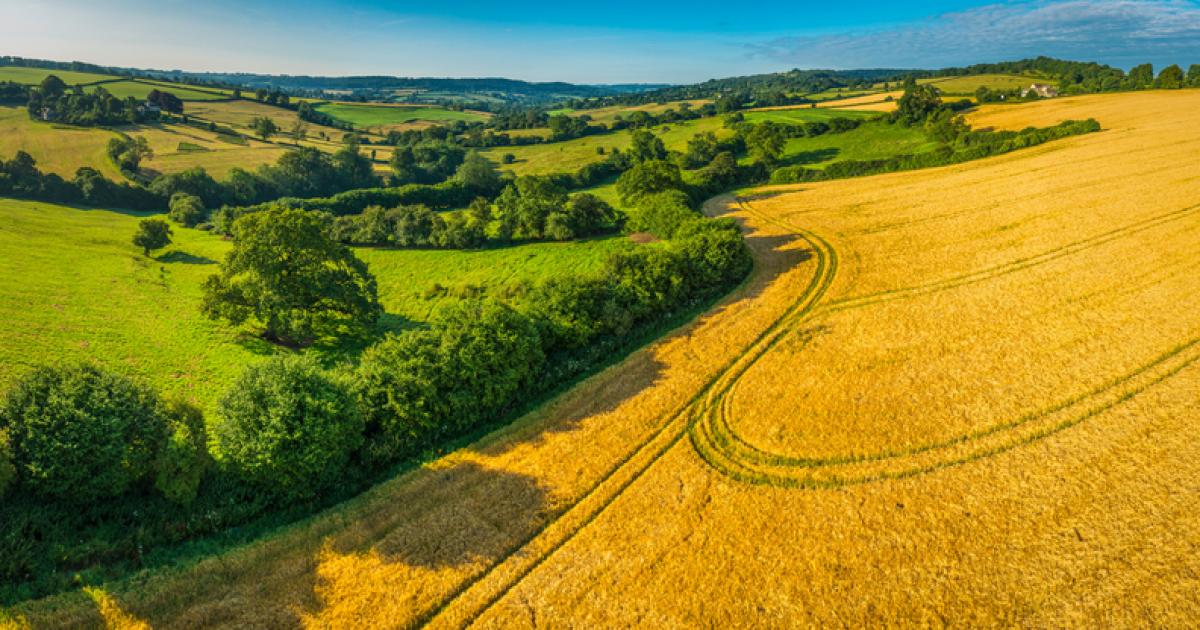
While activity has remained relatively subdued compared with the post-pandemic surge, demand for quality farms, productive land and diversified rural businesses has remained strong, with well-presented properties continuing to attract competitive bidding from a broad range of buyers.
Across the country, supply remains one of the biggest factors shaping the market.
There are simply not enough farms coming forward to satisfy demand, particularly in the east where productive arable ground is highly sought after.
According to Savills, prime Scottish arable land is now averaging just under £12,000 an acre, remaining above the wider Great Britain average and underlining Scotland’s continuing appeal to both farming businesses and long-term investors.
Although softer commodity prices, volatile input costs and changes to inheritance tax reliefs have created greater caution among purchasers, the best farms continue to command strong premiums.
Douglas Orr, farm agent with Strutt & Parker, believes the Scottish market has proved considerably more resilient than many expected.
He said: “2025 was a year that will stick in the mind for some time due to political noise and policy uncertainty, but the Scottish farmland market emerged on a solid footing.”
Mr Orr added that limited supply continued to underpin values despite a challenging backdrop for agriculture.
Indeed, figures from Strutt & Parker show only around 28,000 acres of farmland were publicly marketed across Scotland during 2025, fewer than the previous year and below the five-year average.
The reduction was particularly noticeable across the north-east, traditionally one of Scotland’s busiest farming regions, while only a handful of larger estates reached the open market. More than four-fifths of farms offered for sale extended to fewer than 500 acres.
For family farming businesses hoping to expand, this restricted supply continues to present both opportunities and frustrations.
Many purchasers remain keen to secure neighbouring land to improve operational efficiency, spread fixed costs and strengthen succession plans. However, opportunities often arise only once every generation.
Where neighbouring farms do become available, competition frequently extends well beyond traditional farming buyers.
Private investors continue to regard agricultural land as a relatively stable long-term asset, while environmental markets, forestry interests and lifestyle purchasers are also active in selected locations.
Diversification opportunities have become increasingly influential in purchasing decisions.
Properties offering renewable energy potential, tourism income, woodland creation opportunities or residential development prospects often attract considerably more interest than land capable of generating agricultural returns alone.
Location also remains critical.
Prime arable counties including East Lothian, Angus, Fife and parts of Perthshire continue to achieve Scotland’s strongest values, reflecting excellent cropping potential and consistent demand from established farming businesses.
According to Strutt & Parker, values exceeding £10,000 an acre were consistently achieved for prime eastern arable land throughout the year.
Elsewhere, productive mixed units and good-quality grassland have also remained attractive, although values naturally reflect local demand, infrastructure and alternative land uses.
Savills notes that Scottish farmland continues to outperform many other parts of Britain because buyers remain focused on long-term ownership rather than short-term market fluctuations.
The firm’s latest review states that concerns surrounding falling land values in Scotland have largely proved unfounded, with the market remaining remarkably stable despite broader economic pressures.
Nevertheless, buyers are becoming increasingly selective.
Properties requiring significant investment, suffering from poor infrastructure or lacking modern buildings can take considerably longer to sell than they might have done several years ago.
Equally, ambitious asking prices unsupported by local evidence are finding less favour in today’s market.
Professional agents suggest realistic pricing and strong presentation have become more important than ever.
Environmental considerations are also beginning to influence valuations.
Woodland creation, peatland restoration, biodiversity enhancement and natural capital projects continue to generate interest, although these markets remain highly site-specific and rarely replace the value generated by productive agricultural land.
For many vendors, environmental opportunities are increasingly viewed as an additional source of income rather than the principal driver behind a sale.
Meanwhile, family succession continues to influence many sales.
An ageing farming population, together with continuing uncertainty over taxation and future agricultural support, is prompting some businesses to reassess long-term ownership structures.
However, advisers report that relatively few farming families are making rushed decisions.
Instead, many continue to seek professional advice before considering restructuring, partnership changes or outright sales.
Across the wider rural property sector, residential demand remains supportive.
Farmhouses with attractive rural settings continue to command healthy interest, particularly where properties combine lifestyle appeal with manageable acreage.
Smaller farms capable of supporting diversification enterprises, equestrian businesses or tourism ventures also remain popular among non-traditional buyers.
Looking ahead, market commentators expect activity to remain measured rather than buoyant.
Higher borrowing costs than those experienced during the exceptionally low interest rate era inevitably reduce purchasing power for some farming businesses.
At the same time, ongoing uncertainty surrounding agricultural policy, environmental regulation and future support payments encourages careful decision-making.
Yet the fundamental attractions of Scottish farmland remain unchanged.
It remains a finite asset with strong long-term demand, significant food production potential and increasing environmental importance.
As Savills concludes, productive Scottish farmland continues to command a premium because buyers recognise its scarcity and enduring value.
For Scotland’s farming community, that resilience offers reassurance.
While the pace of the market may have moderated, quality land continues to attract committed buyers, and with supply expected to remain constrained, values appear well supported despite the wider economic headwinds facing agriculture.












Leave a comment