
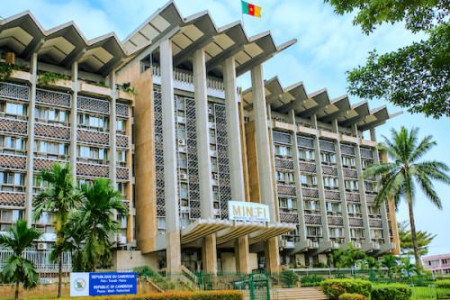
Cameroon is preparing to raise a $690 million (about CFA400 billion) environmental, social, and governance (ESG)-linked loan with support from international financial partners, as the government seeks to diversify its funding sources and reduce borrowing costs.
The planned transaction, which has yet to be finalized, would complement the CFA474 billion the government has already raised on international markets in 2026. The proposal was disclosed in the June 2026 edition of Cameroon’s monthly public debt report, published on July 27 by the Autonomous Sinking Fund (CAA). The report states that the government intends to secure a “$690 million ESG-linked loan.”
However, the CAA does not disclose the loan’s maturity, grace period, or expected interest rate. As a result, references to a 15-year tenor, a five-year grace period, or competitive financing terms are not supported by the published report.
Equivalent to 12.5% of 2026 financing needs
Cameroon’s 2026 finance law estimates the government’s gross financing requirement at CFA3.197 trillion, or about 8.8% of gross domestic product. Nearly 67% of that amount is expected to come from external financing.
At roughly CFA400 billion, the proposed ESG-linked loan would cover about 12.5% of the country’s financing needs for the year. It would come on top of the CFA474 billion raised during the first quarter of 2026 through a private placement in international capital markets.
The planned borrowing comes as higher global interest rates have prompted authorities to recommend a cautious approach to external borrowing. The government is seeking to avoid relying too heavily on conventional market financing while borrowing costs remain elevated.
According to the CAA, the ESG-linked structure is intended to diversify financing sources, lower borrowing costs, and improve Cameroon’s access to sustainable finance. The transaction is expected to incorporate guarantees and risk-sharing mechanisms with international financial partners.
Projects and ESG framework remain undisclosed
The report provides no information about the financial institutions involved, the currency in which the loan will be denominated, the expected disbursement schedule, or the proposed guarantee structure.
It also does not identify the projects that would be financed or explain how the proceeds would be allocated among environmental, social, and governance objectives. No eligibility framework, impact indicators, or reporting requirements have been published.
Without those details, it is not yet possible to determine whether the transaction will finance specific eligible projects or take the form of a broader sovereign loan tied to ESG-related commitments by the government.
The CAA’s description of the transaction as an “ESG-linked loan” also warrants caution. Based on the information released so far, the operation cannot yet be classified as a green bond, green loan, or sustainable finance instrument under internationally recognized definitions.
External debt remains the largest component
As of the end of June 2026, Cameroon’s public debt stood at CFA15.607 trillion, equivalent to 44.2% of GDP. Debt contracted directly by the central government totaled CFA14.659 trillion, with external borrowing accounting for 64.5% of that amount.
If fully disbursed, the proposed loan would represent about 2.6% of the country’s outstanding public debt. Its actual impact, however, will depend on the timing of disbursements and how the proceeds are used.
The financing terms will also be critical. According to the CAA, Cameroon’s current public debt portfolio carries a weighted average interest rate of 2.8% and an average maturity of 6.9 years. External debt has an average maturity of 7.3 years.
To provide a financial advantage, the proposed ESG-linked loan will need to offer more favorable terms than conventional commercial borrowing, including the CFA474 billion private placement completed earlier this year.
At this stage, the transaction remains a financing proposal rather than a completed borrowing operation. Its significance will ultimately depend on its final cost, maturity, guarantee structure, and, above all, the publication of a framework identifying eligible projects and the expected environmental and social outcomes.
Amina Malloum












Leave a comment