
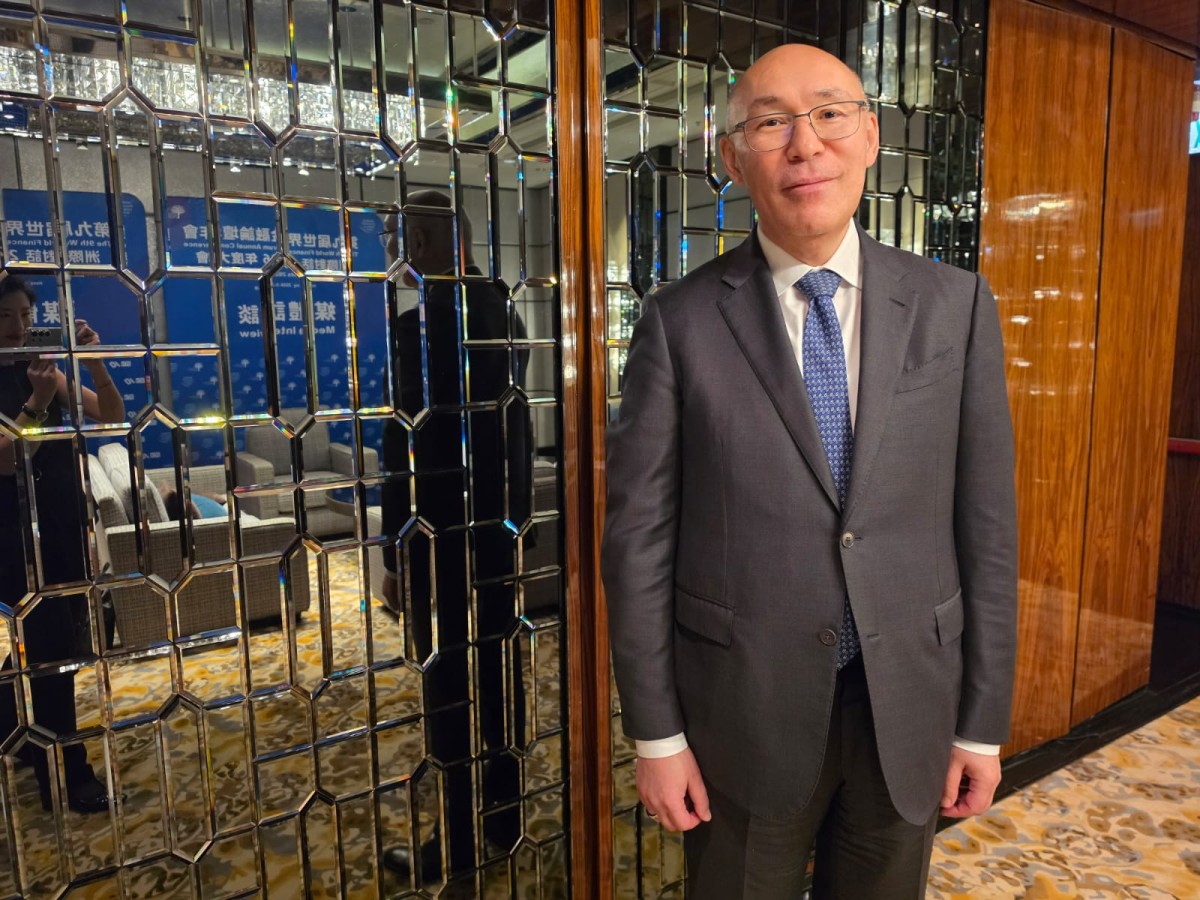
Dr Kairat Kelimbetov, founding Governor of the Astana International Financial Centre and former central bank chief, believes Hong Kong has a critical role to play in financing Kazakhstan’s energy transition.
Now effectively Kazakhstan’s global investment ambassador, Kelimbetov argues that his country possesses world-class wind corridors, some of the highest solar irradiation levels on earth, and vast reserves of uranium and rare earth elements essential to the energy transition.
What it lacks is the green finance to develop them at scale – and that is where Hong Kong comes in, he told The Standard, when a Hong Kong delegation led by Chief Executive John Lee Ka-chiu visits Astana, the capital of Kazakhstan today.
The AIFC, which Kelimbetov modeled partly on Hong Kong’s common-law regime, now hosts over 5,500 companies from more than 90 countries. But the co-author of The Perfect Storm: Navigating the Sustainable Energy Transition sees synergy between Hong Kong’s green finance ambitions and Kazakhstan’s renewable potential.
As of the end of 2025, Hong Kong’s grant scheme has driven total green and sustainable debt volume to nearly US$180 billion (HK$1.4 trillion) – including over US$31 billion in government bonds. This cements the city’s position as Asia’s leading hub, commanding a 40–45 percent share of the region’s international green bond market. Through tokenized green bonds, state-subsidized transition finance, and an internationally aligned framework, Hong Kong offers Kazakh renewable projects a dynamic, highly liquid gateway to global institutional capital.
China Power International Holding, based in Hong Kong, issued China’s first “green panda bond” to finance wind and solar projects in Kazakhstan, exploiting favorable currency spreads to cut costs.
Hong Kong-based Risen Energy has completed projects including the 50-megawatt Chulakkurgan Solar installation, which saves 67,000 tonnes of CO2 annually with backing from the European Bank for Reconstruction and Development and the Green Climate Fund.
Kelimbetov offers a framework tying energy, infrastructure, and finance into a single thesis. “I would invite you to think of at least three of them not as separate opportunities but as three layers of a single proposition: Belt and Road connectivity made operational through Kazakhstan. Each layer requires the layer below it, and Hong Kong capital can participate at every level.”
Hard infrastructure forms the foundation. The Middle Corridor, the trans-Caspian route connecting China to Europe, requires several billion dollars of equity and debt. “The Middle Corridor is no longer optional – it is the primary east-west land bridge for the next phase of Belt and Road.”
Digital infrastructure turns the corridor into something more valuable – data centers, fiber, and AI compute capacity, with hyperscale campuses costing hundreds of millions of dollars each.
“This is the substrate on which fintech, e-commerce, and AI-enabled logistics actually run.”
Financial infrastructure funds it all: a consolidating banking sector, scaling fintech, and deepening capital markets.
Hong Kong investors can participate through equity, dual listings, and cross-border products.
Renewable energy runs through all three layers. The Middle Corridor must meet sustainable standards. Data centers require enormous amounts of clean energy. And the financial layer demands green-labeled instruments meeting Hong Kong’s disclosure standards.
Kazakhstan’s endowment is well-suited: world-class wind corridors, high solar irradiation, and vast uranium and rare earth reserves critical to the global energy transition.
“Hong Kong capital can engage with Kazakhstan as the operating geography of Belt and Road connectivity across all three layers rather than as a series of disconnected sector bets.”
Kairat Kelimbetov believes five to six Kazakh dual listings annually on Hong Kong Exchanges and Clearing and Astana International Exchange would reshape how global investors view the entire Central Asian corridor.
The landmark Jiaxin International Resources dual listing in August 2025 raised approximately HK$1.2 billion – the first time a mining company listed concurrently on both exchanges in Hong Kong and Astana.
“That transaction proved the technical pipe works,” said Kelimbetov, founding Governor of the Astana International Financial Centre, who has been advocating dual listing in both exchanges.
“What it has not yet produced is repeatable volume. I hope regional businesses will recognize the opportunity.”
He identifies three cases where a Hong Kong listing makes strategic sense: first, companies with exposure to the China-Eurasian corridor that are better understood by Asia-based investors than by US or London analysts; second, companies in sectors with deep Hong Kong analyst coverage, including resources, transition-economy firms, and infrastructure platforms; and third, issuers seeking Asian institutional shareholders alongside existing investors.
Hong Kong’s standards are high, bolstered by international-level corporate governance, International Financial Reporting Standards accounts, tier-one auditors, and English-language investor communications. But Kelimbetov sees this as a quality signal. “Kazakh companies that began building these capabilities five or more years ago now have real optionality.”
Rather than sporadic deals, he envisions “three to five Kazakh issuers a year on HKEX over the next decade. That builds an investor community, a research base, and a pricing reference.”
The dialogue is already active: AIFC representatives recently met HKEX in Astana.
Freedom Holding Corp, where Kelimbetov sits on the board, is exploring a Hong Kong listing. “We are quite interested in the market and want to have our footprint in Hong Kong,” he said, deferring specific decisions to the company’s chief executive.
If Hong Kong has a spiritual twin in Central Asia, it is the Astana International Financial Centre – a special economic zone operating under English common law, with its own independent court, regulator, and exchange. Its founding Governor, Kairat Kelimbetov, built it with Hong Kong explicitly in mind.
“We studied the experiences of other financial centers – including Hong Kong – and drew on the best advice the global community could offer,” he said. A 2017 MoU with the Hong Kong Trade Development Council formalized the partnership. “I would like to express my deep appreciation of Hong Kong’s and HKTDC’s support. For Kazakhstan, China and Hong Kong are natural partners.”
Yet building the infrastructure was the easy part. “The unexpected challenge was patience. Convincing global capital to allocate to a new jurisdiction takes considerably longer than building the jurisdiction itself. The first cohort of international institutional investors is the hardest; everything after them is easier.” That patience was tested by the pandemic and regional conflicts. “The AIFC came through that period stronger, not weaker, which I take as institutional validation. But those turbulent years meant international recognition took us some time.”
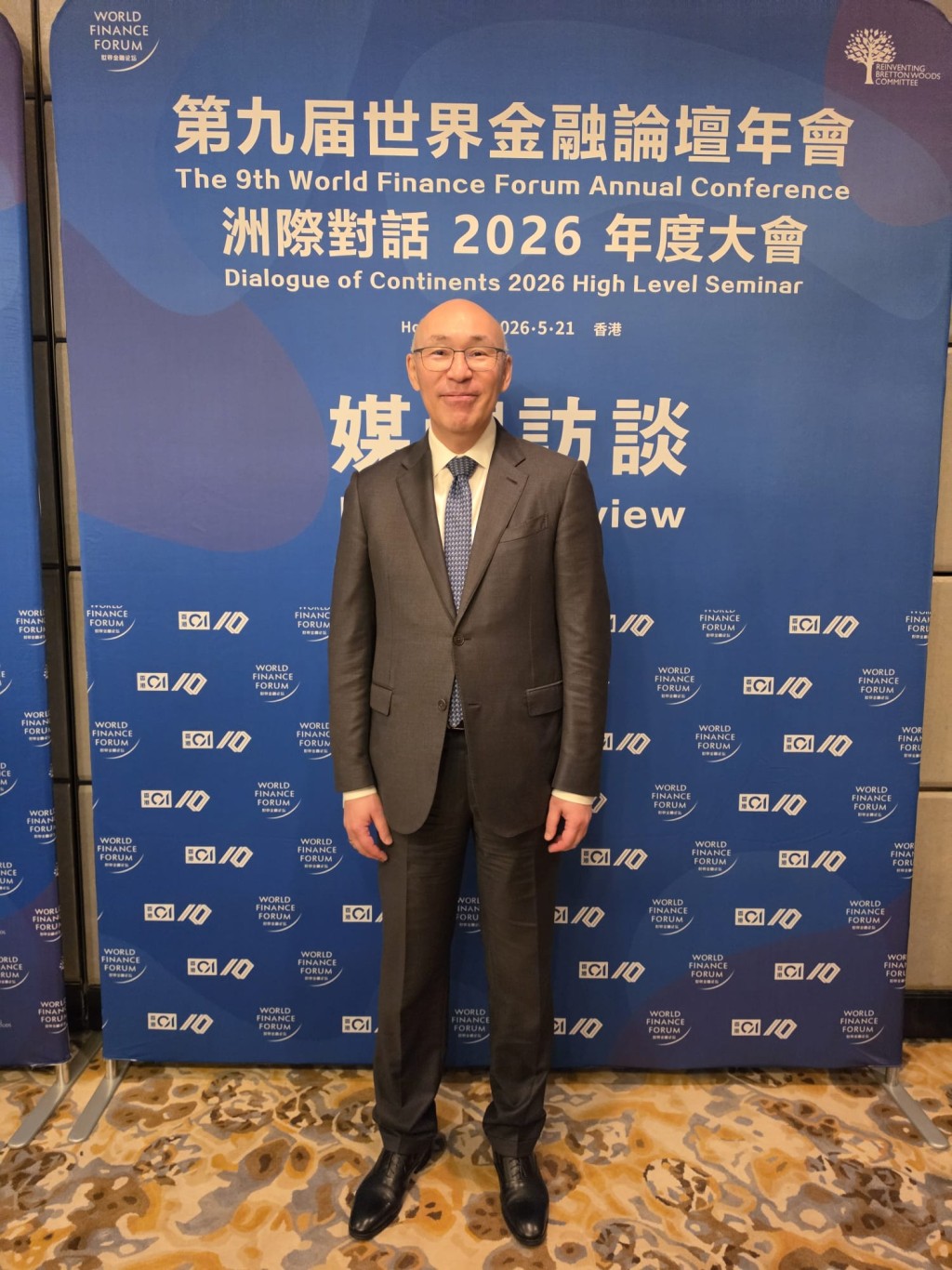
Kairat Kelimbetov joined the 9th World Finance Forum Annual Conference in Hong Kong on May 21.
The numbers vindicate his approach. When Kelimbetov stepped down in 2023, the AIFC had roughly 2,000 registered participants. By 2025, it surpassed 5,500 companies from over 90 countries, with US$6 billion (HK$46.8 billion) raised that year.
“The first 1,000 companies took more than three years, the next thousand took two, the third came in roughly 12 months, and the fourth was reached in under a year. That acceleration after my departure is the success I am proudest of, because it proves we built a reliable institution.”
On competition with Dubai, Hong Kong, and Istanbul, he reframes the question. “Those three centers compete for things the AIFC is not trying to compete for.”
Astana offers something distinct: “It is still the only English common-law jurisdiction sitting directly upstream of Central Asia’s productive economy.” The opportunity spans 80 million people, world-class uranium and rare earth reserves, the Middle Corridor, and a sovereign investment-grade rating.
The real framing is complementarity. “A Hong Kong investor allocating to Central Asia ideally uses Hong Kong’s capital infrastructure and Kazakh local infrastructure together. We have already seen successful dual listings. That is the model we want to deepen – and it serves Hong Kong capital best.”








Leave a comment