
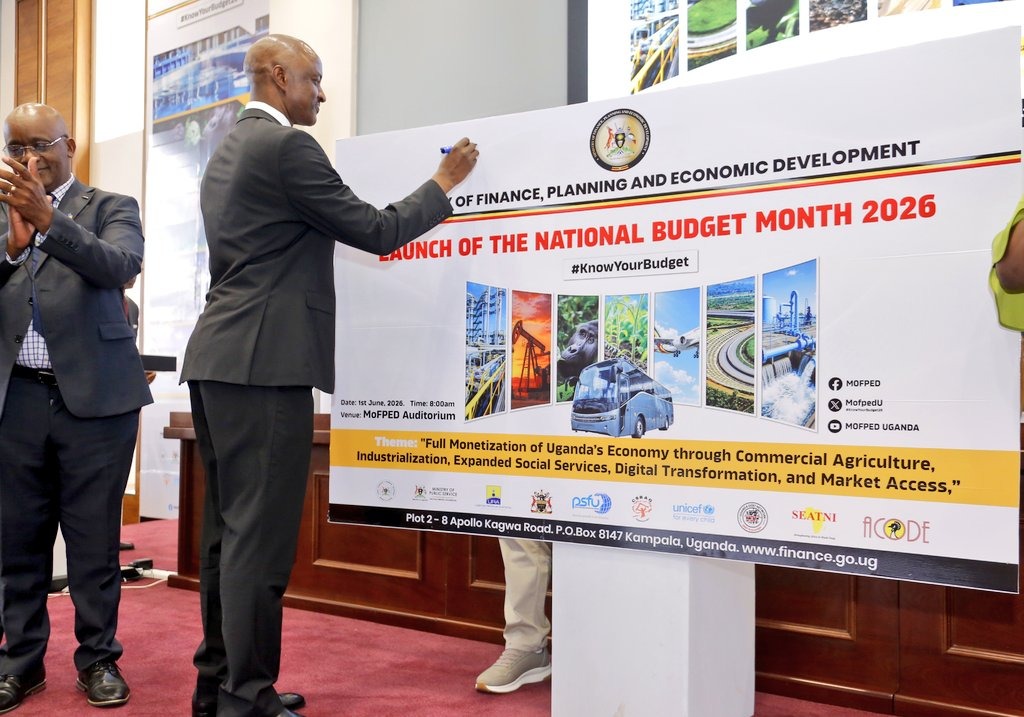
Uganda Launches Budget Month, Expands Public Engagement Tools as Treasury Urges Accountability
Uganda on Monday launched its National Budget Month for the 2026/27 financial year, rolling out expanded public engagement and accessibility tools as the government seeks to deepen transparency and strengthen oversight of public spending.
Permanent Secretary and Secretary to the Treasury Ramathan Ggoobi said the annual campaign was designed to ensure wider understanding of the national budget and improve citizen participation in monitoring government expenditure.

He said preparation of the 2026/27 budget began in July 2025 and involved nationwide consultations with the President, Cabinet, Parliament, civil society, local governments, development partners, academia, the private sector and citizens.
“The national budget reflects our shared goals for better services, economic growth, accountability, but also a better future for all our citizens,” Ggoobi said.
As part of the engagement strategy, the Ministry of Finance said it will produce a Citizens Guide to the Budget, alongside Braille versions for the visually impaired, child-friendly versions for school-going children, and audiovisual formats intended to broaden access to budget information.
Officials said the materials are aimed at improving budget literacy and ensuring that information on public spending reaches diverse groups across the country.
Ggoobi said the initiative reflects government’s commitment to transparency, accountability and inclusive governance in public finance management.
“I wish to sincerely appreciate our National Budget Month Partners for their continued cooperation and commitment to advancing transparency, accountability, and good governance within the budget process,” he said.
The 2026/27 budget is anchored on the theme “Full Monetization of Uganda’s Economy through Commercial Agriculture, Industrialization, Expanding and Broadening Services, Digital Transformation and Market Access.”
Ggoobi said the strategy focuses on priority sectors referred to as “ATMs” agro-industrialisation, tourism and mineral development alongside science, technology and innovation as key enablers of growth.
“It’s about ATMs and their enablers,” he said.
He also reiterated government’s call for stronger accountability and improved implementation of public programmes, saying the success of the budget depends not only on planning but execution and oversight.
“The problem is implementation discipline,” he said.
The Budget Month campaign, introduced in 2018, is intended to promote public participation in budgeting through consultations, media engagements and community outreach programmes across the country.
According to the Ministry of Finance, Uganda’s budget transparency score improved from 58% in 2021 to 59% in 2023, while budget oversight performance rose from 59% to 67% over the same period.
Civil society organisations and private sector actors welcomed aspects of the upcoming budget but raised concerns over domestic borrowing, interest rates and implementation bottlenecks affecting service delivery.
The government says the 2026/27 budget will focus on improving efficiency, expanding revenue collection and ensuring public spending delivers measurable economic impact as Uganda targets stronger economic growth.










Leave a comment