
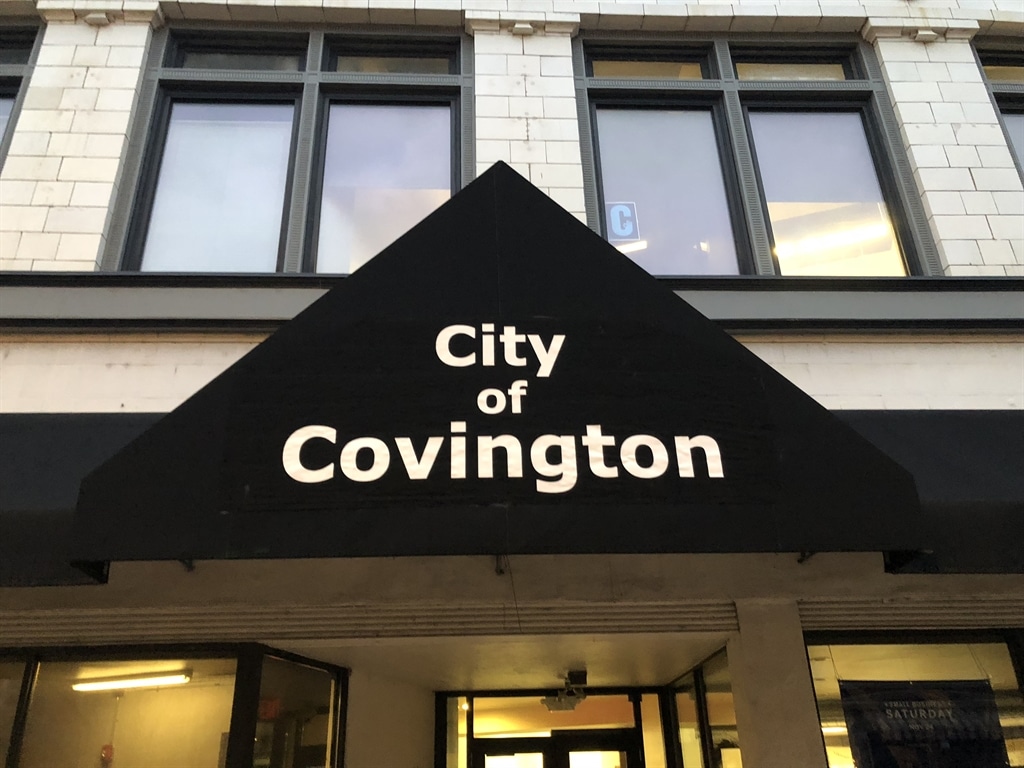
The Covington Board of Commissioners is considering raising both its real estate property tax rate and its personal property tax rate. The commissioners will cast their final votes on the rates next week.
The board performed a first reading of the ordinance establishing the tax rates for the 2026 fiscal year, which runs from July 1, 2025, to June 30, 2026, at its caucus meeting Tuesday evening.
Readings of legislation aren’t usually performed at caucus meetings, but the board voted at the meeting to go into legislative session and perform a first reading. Tuesday night also saw a public hearing where residents could speak about the proposed rate, but no one spoke during the hearing.
The proposed real estate property tax rate is $0.287 per $100 of assessed property value. The current real property tax rate is $0.277 per $100 of property valuation.
The proposed personal, or tangible, property tax rate is $0.375 per $100 of assessed property value. The current rate is $0.326 for every $100 of assessed property value.
Consult the chart below for a recent history of the property tax rates in Covington.
Property taxes are broken down into several categories. The first and usually largest chunk of your tax bill is real property tax, sometimes referred to as real estate property tax. This is essentially a tax on everything you own that’s nailed down. For residents, this means houses and other real estate property. For businesses, this means office buildings and other buildings and facilities used to conduct business.
Tangible personal property, on the other hand, generally refers to property that isn’t real estate. This mostly applies to businesses and includes machinery and other movable equipment and supplies.
The rates proposed on Tuesday represent compensating rates plus 4% increase, known more often as comp+4 rates.
Read LINK nky’s explainer below for a deeper explanation of how property taxes work.
How do property taxes work?
Property taxes are broken down into several categories. The first and usually largest chunk of your tax bill is real property tax, sometimes referred to as real estate property tax. This is essentially a tax on everything you own that’s nailed down. For residents, this means houses and other real estate property. For businesses, this means office buildings and other buildings and facilities used to conduct business.
Tangible personal property, on the other hand, is another form of property that isn’t real estate. Depending on where you live, residents may not be taxed on personal property at all–this will vary by jurisdiction.
Depending on where you live, other tax-adjacent fees may apply.
“These rates were reviewed during the [fiscal year] ’26 budget process and are designed to meet the city’s general operating expenses, fund public improvement and provide a safety fund for the payment of interest on bonding indebtedness and the redemption of bonds maturing during the fiscal year ending June 30, 2026,” said Covington Finance Director Bre Gaffney at Tuesday’s meeting.
The commissioners did not engage in discussion on the matter on Tuesday.
Covington property taxes were high in the 1970s—the real property tax rate was $0.78 in 1975—and began to decline in 1977. Rates fluctuated throughout the subsequent decades and most recently leveled off in fiscal year 2018 with a real property rate of $0.327 and a tangible rate of $0.349. Those rates persisted until fiscal year 2023.
Next week’s meeting will begin at 6 p.m. at Covington City Hall on Pike Street. It will include a portion for public comment.










Leave a comment