
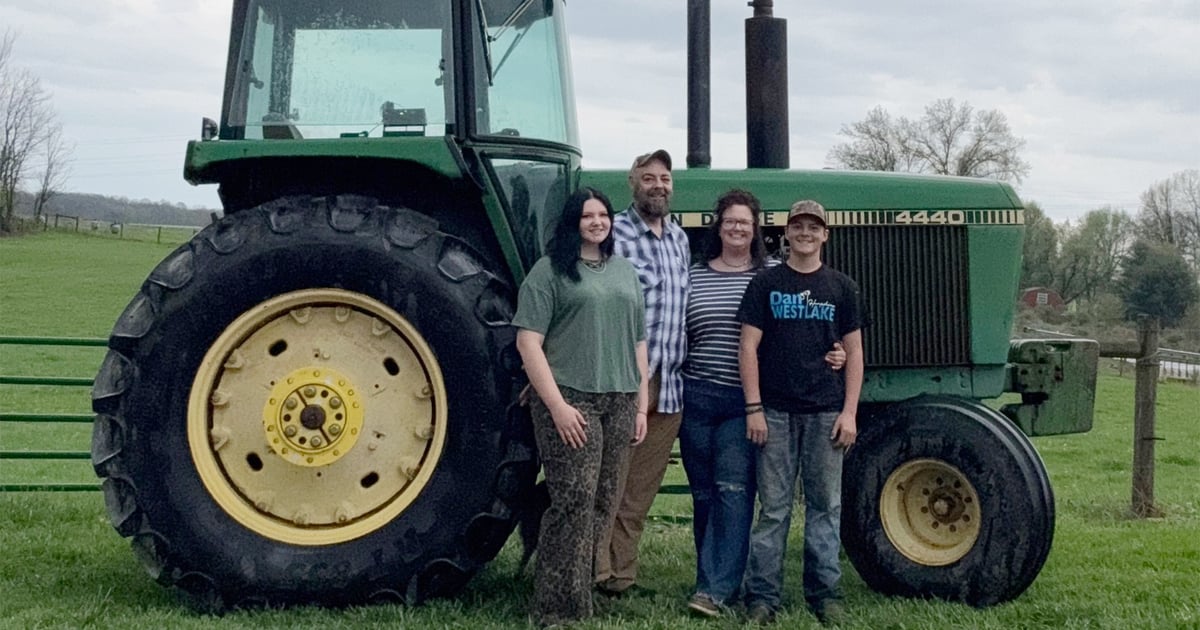
Wayne Greier looks at his farm in Mahoning County, Ohio, with pride. He’s the sixth generation of his family to toil soil in Green Township, about 15 miles west of the Pennsylvania state line.
“My dad worked the land until the day he died. I’ve put a lot of blood, sweat and tears into it,” he said.
Then, COVID-19 happened. Greier said he got so sick that it nearly bankrupted him. He spent 40 days in the hospital, had seven abdominal surgeries and racked up $1 million in medical debt.
When a solar company in 2021 approached him about leasing 600 of the more than 1,000 acres he farms, he saw it as a needed cash injection — a way to pay his medical bills and secure his farm’s future. But a state law in Ohio, Senate Bill 52, prevented him from going through with the project on his own land.
Now, he’s one of the state’s loudest advocates for private property rights.
“After all this happened, I decided that I would advocate any way possible so that nobody has to go through what I did and to prevent this in the future,” Greier said.
Large-scale solar on farmland is a contentious issue. In Ohio, Senate Bill 52 allows local leaders to ban large-scale solar in unincorporated townships. According to Ohio Citizen Action, as of last September, 37 of the state’s 88 counties passed bans on large-scale solar projects in at least one township, reflecting widespread concern over the impact on farmland.
But the law also gave residents the right to petition to overturn these county-level bans, which is what’s happening now in Richland County, in the center of the state. The county banned large-scale solar and wind in 11 of the county’s 18 townships. Landowner rights advocates collected more than 3,000 signatures to place the issue on the ballot on May 5. A “yes” vote means the ban stays in place; a “no” vote overturns it.
Greier’s paying close attention to the upcoming vote. But his own story is a microcosm of how contentious solar and landowner rights have become.

A billboard asking voters to vote “no” in an upcoming solar ban referendum in Richland County, Ohio, shows how contentious the issue has become. (Courtesy of Tracy Sabetta)
From farmer to property rights advocate
Greier said the concerns over his project always centered on the idea of taking prime farmland out of farming, even though a transmission line runs through his farm.
Public sentiment turned against him, he said, and things got ugly quick.
“All of a sudden, this mob was created that was anti-solar,” Greier said. “And they surrounded my house with signs. And people were telling me to move out of the community, and I had to pull my kids out of school because the other kids were saying that we were going to ruin everybody else’s drinking water, and we were going to ruin the community. It was really bad. I went through a really dark time because of that.”
Two years ago, Green Township, where he farms, banned large-scale solar and wind projects. Even though he signed his contract before the ban was approved, Greier said it didn’t have the required impact study submitted to the Ohio Power Siting Board, which had final say over it. So, for now, the project is dead.
But the damage was done. He said his neighbors no longer talk to him, and others have stopped doing business with him.
His health problems limited the amount of farming he could do, and the bank threatened to foreclose his home. He had to sell land and most of his equipment, including a Great Plains 24-row center-fill planter, a deep ripper, some tillage equipment, a field cultivator and more. Several tractors he had to turn back in on lease.
Greier thought of moving away with his family to start over. But it’s hard to do. His father’s ashes are spread on the land, and his family has been connected to it for generations.
He is slowly getting back on his feet. He’s leased his land to another farmer who pays him to help. He runs equipment, markets the grain and does other things. His family raises 70 sheep, 15 goats and 10 cows that are fattened out for local beef. He owns a little less than 1,000 acres.
“I get to do what I love and help with the farm, and he took the reins with the financial burden,” Greier said. “He takes the risks and everything, but at least I get to still plant and operate on the farm on my ground that’s been in my family for six generations.”

This map provided by Ohio Citizen Action shows counties in gray that have passed large-scale solar bans in unincorporated townships. As of last September, 37 of the state’s 88 counties passed bans on large-scale solar projects in at least one township, reflecting widespread concern over the impact on farmland. (Courtesy of Ohio Citizen Action)
Greier has spoken many times to groups in Richland County in favor of overturning that county’s ban.
This issue has turned bitter with signs and billboards popping up for and against the ban.
Matt Smith, who farms 500 acres in neighboring Marle County and leases 50 acres in Richland County, supports overturning it. “For me, it’s about property rights,” he said. “That’s been the No. 1 issue for me.”
Smith has worked with cities to develop solar projects, including a 2.5-megawatt solar project in Shelby on land he once owned. On his own farm, he has a 25-kilowatt solar array on his barn roof.
Smith said the positives of solar, including the potential for agrivoltaics — farming under the panels — outweigh the negatives and are a better alternative to data centers and houses.
“In the big picture, the change of farm ground, whether it’s for housing developments, urban expansion, the pressure has been there on farmland and will continue to remain. It’s a delicate balance,” he said.
Farmer Dale Hulit wants to keep the ban in place. He grows more than 1,000 acres in Weller Township in Richland County. He is a township trustee, and Weller is one of the 11 townships with a ban in place.
“When I voted to approve the ban, I had mixed feelings about it,” he said. “I’m usually a proponent of property rights. But on the flipside, I also know it’s more than just the landowner affected; it’s also the neighbors affected.”
His main concern? What happens down the road, in 10 or 20 years, when these arrays have to either be repowered or decommissioned? He thinks the damage to farmland will be too great.
“From a farmer standpoint, I do not ever see this land being able to be put back into production,” Hulit said. “I may be wrong, but I just think there will be too much damage to ever make it farmable again.”

Greier has spoken many times to groups in Richland County, Ohio, in favor of overturning that county’s large-scale solar ban. (Courtesy of Tracy Sabetta)
Lessons learned
Greier has crisscrossed the state speaking on landowner rights and has joined the board of the Renewable Energy Farmers of America, which advocates for landowner rights and renewable energy projects.
Greier said farmers who want to put in a solar project should do all they can to educate themselves and their community, something he admits he should have done more of when his project was proposed.
“Get out there and educate yourself,” he said. “Make sure you know a lot about it and the truth about it, because the lies and misinformation will run rampant so fast. Make sure that you can navigate through those lies and be ready to answer questions that people are going to have. Answer them honestly and openly with sources.”
No easy solution
Still, Greier thinks it’s fundamentally wrong that others get to tell landowners what they can and can’t do with their land.
“We shouldn’t be allowed to decide what our neighbor does with their property without having to put something into it,” he said. “We all make trash, but nobody wants the landfill. At what time are we going to start holding people accountable for their power and their energy, and say that you can’t always push it off on someone else?
“We all expect our phones to be charged when we plug them in, our light switch to turn on when we flip it. Well, guess what? That power takes accountability. And if you have a farmer landowner that’s willing to take that risk and put that on their property, that can’t always be someone else’s decision.”
For Hulit, who’s on the frontlines of this issue, it’s a debate with no easy answers.
“I don’t know what the solution is. Property rights, they’re not as simple as they sound,” he said. “As a trustee, I also have to look at it from the standpoint of not just the property owner, but how does it affect the community at large? I think taking productive farmland out of use is not a good choice.”









Leave a comment