
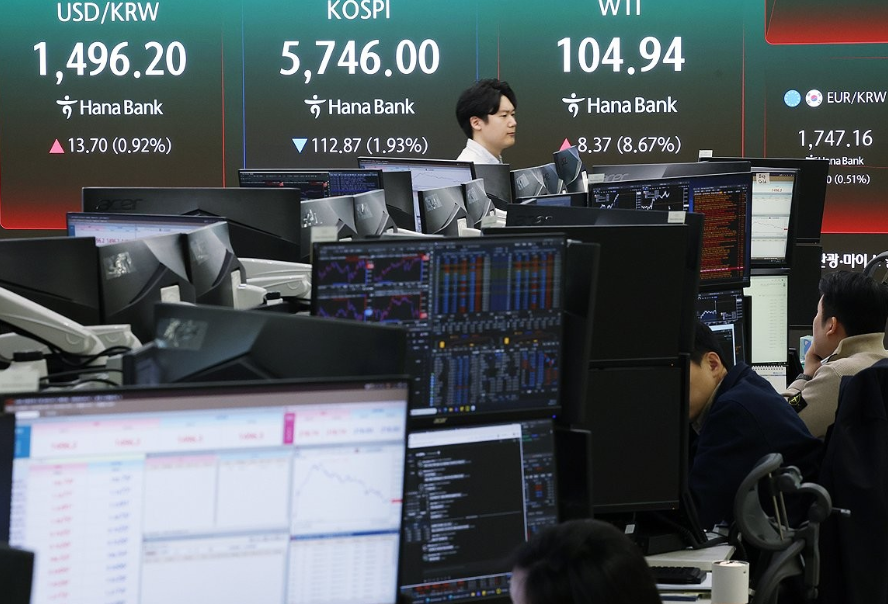

High oil prices, high interest rates, and a weak won have simultaneously hit markets following the U.S.-Iran conflict, driving continued volatility. Securities firms are now actively screening for defensive stocks that can pass cost burdens to consumers or have limited exposure to external variables.
The Korea Exchange (KRX) food and beverage index rose 0.83% to 4,890.23 on Monday. The index, which includes KT&G (033780.KS), Samyang Foods (003230.KS), Daesang (001680.KS), and CJ CheilJedang (097950.KS), has climbed for four consecutive trading days, already surpassing its closing level of 4,812.50 on the third day of the month when the war began. The KRX consumer staples index, composed of similar stocks, also rose 0.64% to 1,736.23, marking four straight days of gains. The KOSPI telecommunications index edged up 0.22% to 677.01, extending its winning streak to seven trading days.
Concerns over prolonged high oil prices underpin this trend. WTI crude futures temporarily dipped below $90 per barrel before climbing back above $100. This remains elevated compared to levels below $70 before the conflict. Many analysts believe the $100 mark is becoming the new baseline, as damage to Middle Eastern oil facilities and the Hormuz Strait blockade during the war will take time to resolve, with the potential for tanker transit fees adding further pressure.
Historical data confirms defensive stocks’ relative strength. Analysis by KB Securities and QuantWise of oil price levels and sector returns since 2021 shows that when oil traded between $84 and $121 per barrel, utilities, defense, telecommunications, trading companies, and holding companies posted annual returns above the KOSPI average. Telecommunications and utilities provide essential services with demand largely insensitive to economic cycles, while defense stocks benefit from heightened geopolitical risks. Financial sectors including banks and insurance are also classified as defensive plays that outperform the KOSPI when high oil prices feed through to inflation and interest rates.
However, not all defensive stocks are performing equally. The KRX utilities index fell 1.34% on Monday. The sector, with heavy exposure to raw material imports, faces rising cost pressures as oil climbed back above $100. Healthcare stocks are struggling with disappointing earnings, and some food and beverage companies are seeing cost increases outpace price hikes.
Experts therefore emphasize identifying stocks that can improve operating margins even after stripping out currency effects as true defensive plays. Hana Securities highlighted Jeju Air (089590.KS), Korea Electric Power Corporation (015760.KS), Lotte Chilsung Beverage (005300.KS), and Orion (271560.KS) as companies that have overcome high exchange rate penalties through price pass-through and operational efficiency. These stocks could see significant margin improvement if external conditions stabilize, according to the analysis.










Leave a comment