
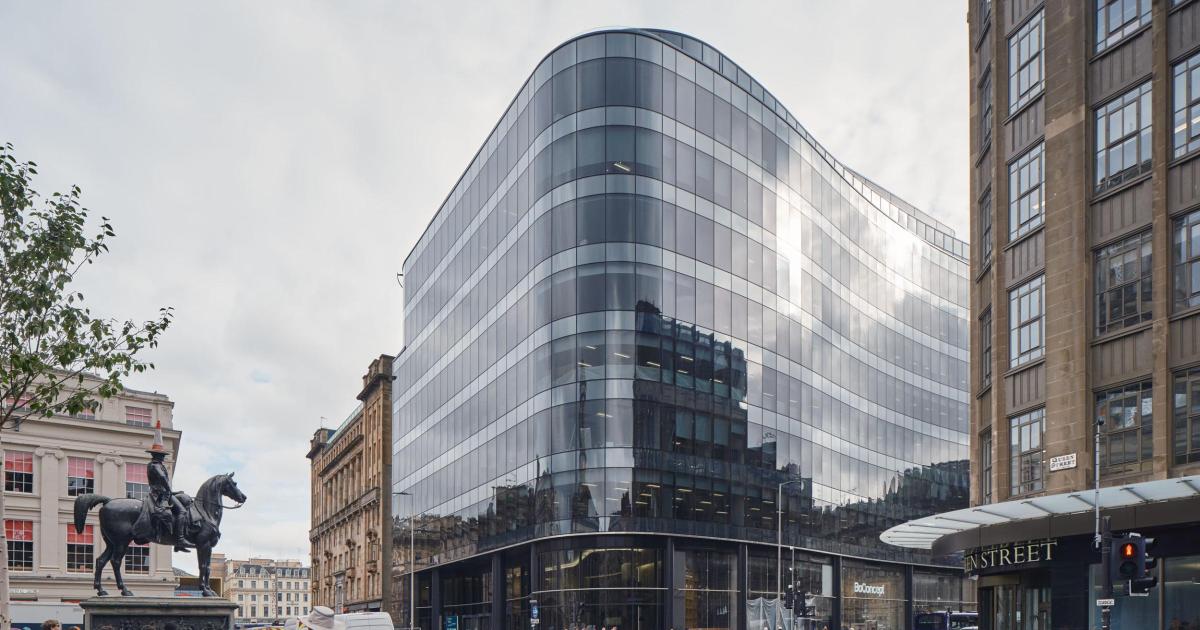
In the five years to April 2026, Glasgow City Region recorded 149 foreign direct investment (FDI) projects. This is up from 139 projects in the five years to April 2021.
Recorded FDI capital expenditure for the region in the latest five-year period was £3.66bn. This is up by 99% from £1.84bn in the five years to April 2021.
And the total number of FDI jobs for the five years to April 2026 totalled 9301. This is up 50% on the figure of 6188 for the previous five years.
Top-five sectors and source countries for investment
Glasgow City Region’s top-five sectors for FDI in the latest five-year period are business services, textiles (retail), renewable energy, software and information technology, and food and beverages.
Among recent major wins, Japan’s Hitachi Energy late last month launched a UK engineering centre of excellence in Glasgow, at an event attended by First Minister John Swinney. This will lead to the creation of around 100 specialised roles, including engineers, project managers and technical specialists focused on delivering critical grid infrastructure.

Laura Fleming, managing director of Hitachi Energy UK and Ireland, said: “Our new Glasgow engineering centre of excellence is about building the capability the UK needs to deliver major grid upgrades at pace. Scotland is already central to the UK’s clean energy future, and this expansion will help ensure that more of the value created by that transition is captured here – through high-quality jobs, new career pathways and stronger local supply chains.”
The top-five source countries for FDI for Glasgow City Region in the last five years are the US, Germany, France, Switzerland and Ireland.
What is attracting investors to Glasgow City Region and how does it compare with other UK cities?
Sam Barnett, head of Glasgow City Council’s Invest Glasgow operation, highlighted the city’s “scale, talent and innovation”, as well as its track record of delivering, as key draws for overseas investors.
Asked about the attractions of Glasgow for such investors, she told The Herald: “Investors are drawn to places with ambition, authenticity and the ability to deliver. They want confidence that growth will happen – and that people will want to live and work there too.
Read More:
“Glasgow understands its economy and as a result is strategically attracting and aligning investment to support our growth ambitions. We combine the scale, talent and innovation of a major city region with a track record of turning ambition into action. There is genuine momentum here. With strong partnerships, growing investment and a clear vision for the future, we’re creating the conditions for the next wave of growth. Glasgow isn’t trying to be the next version of somewhere else – it’s building on the strengths that make it uniquely Glasgow. Glasgow has always done things its own way.”

Excluding London, Glasgow City Region is second only to Manchester among regional UK cities for FDI by number of projects in the latest five-year period, and is followed by Birmingham in third place and Edinburgh in fourth. The Glasgow City Council area sits just below Edinburgh in this table, in fifth spot, if taken in isolation.
In the previous five-year period, again excluding London, Glasgow City Region was in third place behind Manchester and Edinburgh by number of FDI projects, ahead of Birmingham in fourth. The Glasgow City Council area taken in isolation was just behind Birmingham in fifth during this period.
Taking the Glasgow City Council area in isolation, the local authority’s analysis of fDi Markets’ data in response to The Herald’s questions shows a dip in the number of projects when the latest five-year period is compared with the five years to April 2021, but a surge in capital expenditure and job creation.
On this basis, in the five years to April 2026, Glasgow recorded 103 projects, compared with 110 projects in the previous five years, a 6% decrease.
In spite of this fall, capital expenditure doubled to £1.73bn in the five years to April 2026 from £861.12m in the previous five years.
The number of new jobs announced in the five years to April 2026 increased by 44% to 6902, from 4787 in the previous five years, the analysis of the data shows.
A top five of what makes Glasgow ‘stand out’
Mulling the question of why foreign direct investors are attracted to the city and surrounding area, Invest Glasgow listed the “top five” aspects which it believes make the city region “stand out”.
First is “scale”, with Invest Glasgow describing the city region as “Scotland’s largest economic engine”.
Read More:
It is also the UK’s fourth-biggest city region, and Scotland’s largest city representing “one-third of all jobs, businesses and population, 855,000 jobs and 50,000 businesses”, Invest Glasgow said.
The second stand-out feature flagged is “strong innovation-led growth and ecosystems”, with Invest Glasgow declaring: “Glasgow City Region has been one of the UK’s fastest-growing regions with significant growth ahead. Glasgow is one of the UK’s strongest scale-up ecosystems. We are globally recognised for our innovation cluster strengths: health and life sciences, energy and net zero, digital and enabling technologies, precision engineering, advanced manufacturing.”
Invest Glasgow observed the economic output of Glasgow City Region was £60.2 billion in 2023 on the gross value added measure.
It noted the city region had achieved 19.1% GVA growth over the past five years, compared with a UK average of 14.5%.
Invest Glasgow flagged “credibility and partnerships” as the third aspect which makes the city and surrounding area stand out.

It said: “What sets Glasgow apart is the strength of its collaboration and genuine partnership. Working closely with governments and UKRI (UK Research and Innovation), industry and academia, we are creating the right conditions for businesses to succeed.
“Glasgow is one of only a handful of UK regions selected for long-term UKRI innovation investment, demonstrating national confidence in the city’s ability to commercialise research, attract investment and grow technology companies.”
Fourthly, Invest Glasgow flagged a “track record of growth and investment”, declaring that “Glasgow is the second-most popular UK destination for FDI outside London”.
It noted that Glasgow has been “ranked among Europe’s top large cities for attracting foreign direct investment by fDi Intelligence…where it has maintained a top-three position in the 2025 European Cities and Regions of the Future rankings for FDI strategy, ahead of Leeds, Düsseldorf, Torino and Krakow”.
Invest Glasgow said: “The city’s strong performance reflects its partnerships across government, academia, business and communities, alongside significant investment in emerging sectors.”
Financial services success
Fifthly, it flagged “building on globally recognised strengths and delivering new technologies”, declaring: “Glasgow is recognised as a significant global financial centre.”
It noted Glasgow was ranked 43rd out of 120 centres worldwide in the March 2026 Global Financial Centres Index and “is now one of the fastest-growing fintech clusters in the UK”.
Invest Glasgow added: “Glasgow is one of [the] UK’s leading deep tech hubs – a result of sustained investment, world-class research, deep talent pipelines and a genuine partnership model.”
Sue Dawe, Scotland managing partner of accountancy firm EY, said: “Over the last few years, Glasgow has really made its mark for financial services, soaring up the financial services global cities index. Some of those FDI projects have created thousands of high-skilled jobs and attracted multi-million-pound investments – and it’s paid off, with many projects expanding operations once they’re here.”

The accountancy firm flagged US investment bank JP Morgan’s Glasgow operation as an example of one which has expanded significantly.
Figures from EY, which produces an annual FDI attractiveness survey, show Glasgow won 23 projects in 2025. It had won 32 projects in 2024, up from 25 in 2023 and 23 in 2022, with the fall last year coinciding with a sharp drop in the Scottish total from 135 in 2024 to 108 in 2025 and an even steeper percentage fall in the UK excluding London.
Asked by The Herald what was driving the attractiveness of Glasgow from an FDI perspective, the University of Glasgow’s David Waite replied: “Numerous rankings give a perspective on what it takes to attract FDI successfully. Policymakers in Glasgow can point to a number of relatively strong rankings recently, even if the city is not always at the top of the pile.
“Glasgow boasts a number of positive attributes – a qualified and large workforce, a well-established higher and further education sector – yet these provide no guarantee of future success. Other factors such as quality of the business environment and strategy effectiveness are reported, whilst relative costs of production such as wages and rents also factor in for firms.”
Read More:
The broader context
Mr Waite, senior lecturer in urban studies at the university’s School of Social and Political Sciences, added: “The number of FDI projects is the key indicator in a number of rankings, and in recent years this has provided a generally positive narrative for Glasgow policymakers. However, the number of projects is just one part of the story; indeed, we need to look to the quality and persistence of FDI for a fuller picture of economic development impacts.
“What value connections does the investment create in the city region? Is a deep supply chain created; is high-quality employment generated; are knowledge linkages embedded? This suggests other metrics to look to as well. We have a good understanding in Scotland – following previous policy experiments – that such economic impacts of FDI need to be considered over the long run.”
He flagged the importance of artificial intelligence in the emerging picture.
Mr Waite said: “AI is an important area to monitor within a concern for investment – both FDI to support AI in various ways, and how AI is shaping wider FDI patterns in other sectors. This raises both economic and environmental questions. The recently announced AI growth zone in Lanarkshire is a notable place-based policy announcement that will be interesting to track too.

“The global economy is subject to major change as both geopolitical and technological shifts take hold. This may shape the Glasgow economy in profound ways, and this poses significant complexity for local policymakers and the implementation of nascent industrial strategies.”
He added: “At the same time, we know that the local demands on FDI – what form it takes and who benefits from it – is viewed differently from how it was 20 years ago. If the Glasgow City Region’s aspiration for ‘inclusive growth’ is to be achieved, such distributional questions must be in the centre ground.”










Leave a comment